It’s time to splash out on a decent press. I’m in this for the long term, and would like to make some actual money in the process. A professional mindset calls for professional tools. This also involves good planning and preparation in the form of a decent layout to my home studio, aka sitting room.
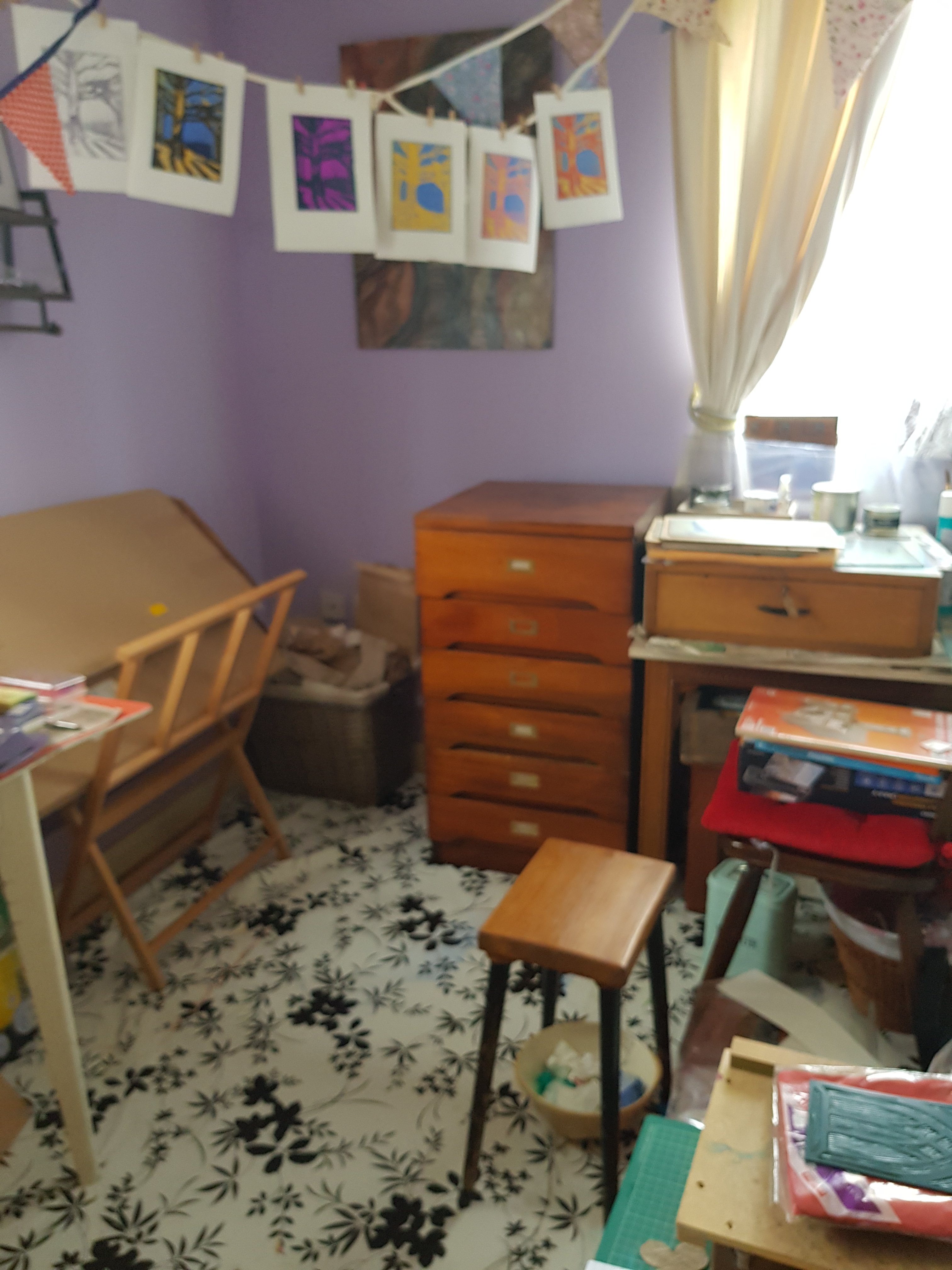
High on my list of things to do has been a reorganisation of equipment and supplies in my studio, hence a hiatus in printmaking for the last couple of days whilst I set this in motion.
Unfortunately, I failed to remember to take the “before” pictures. Oh, well.
The white drawers are destined for a new home in the shed downstairs
Exciting stuff. The new press will fit into the space, left by the drawers, in the kitchen.
I think that perhaps this printmaking lark is going to take over my life. I’m not fighting it much. It’s a fun process and the medium suits my process-orientated way of working. Good times.
To me, art is the expression of a heightened awareness of the world around us, our relationship with it, and the relationship with oneself. This can take on many forms, from hands-on visceral and tactile drawing onto a physical surface, using sound to vibrate the air around us, or through the medium of code, both digital and analogue. Right here, right now, I choose printmaking as the main process through which I wish to express art.
Update
My new No 2 Gunnings Press from Ironbridge Printmakers
I started this project by drawing spiral arrangements in my sketchbook. My thinking was to produce abstract designs for the final series of prints for this course unit.
I then went on to look at other people’s chine collé creations. This one, by Diana Croft, caught my eye. The archway suggested by the tree put me in mind of stained glass church windows. I thought I could have fun using different colours and patterns – including spirals.
Diana Croft
I produced a test plate with a basic church window, as follows :
Test plate
From this I produced my very first chine collé print:
Chine collé test print with tissue and textured paper
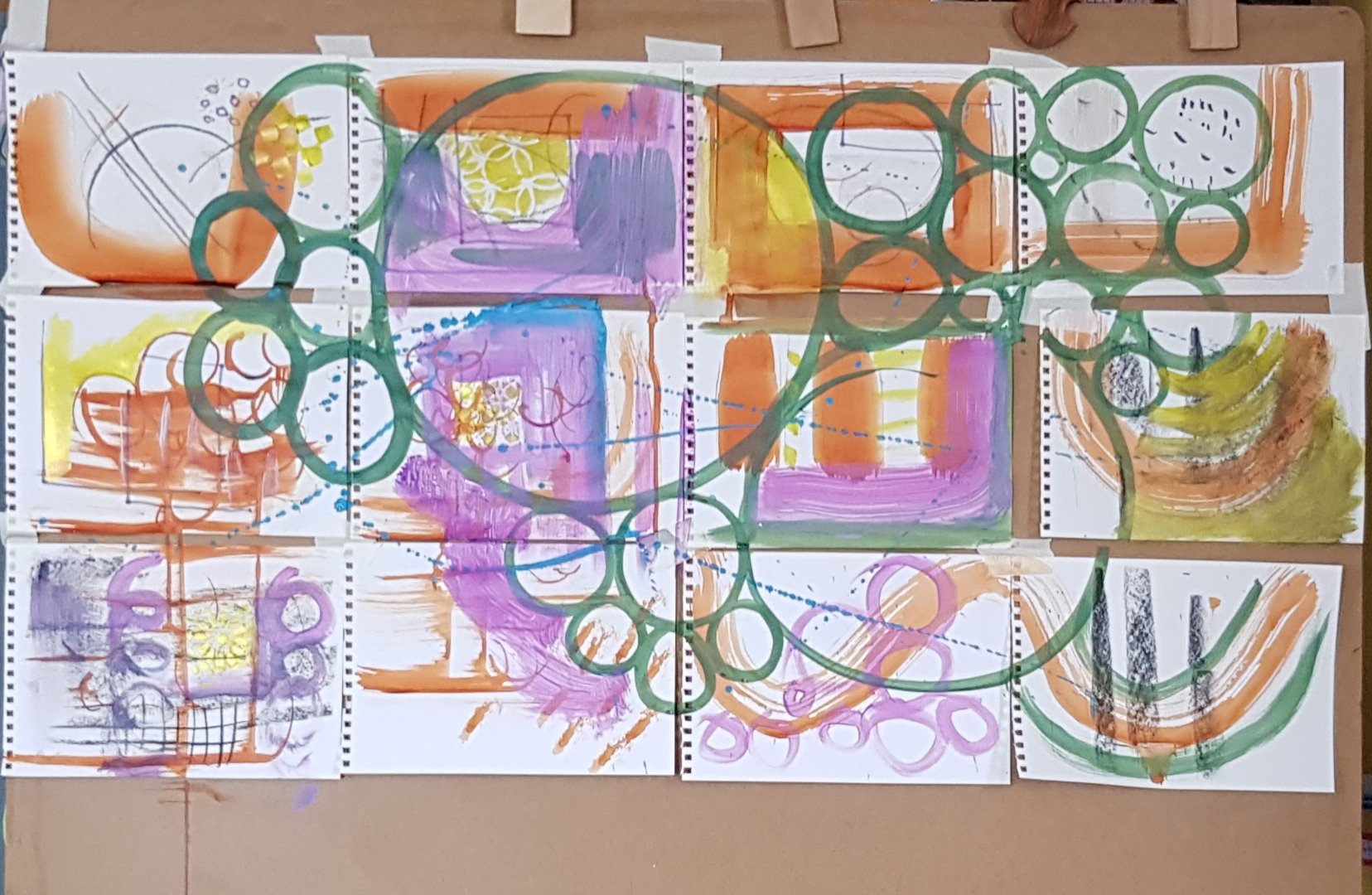
Enthused by this, I designed a slightly more complex image and went off to do something else for a while. That “something else” was, among other things, to dabble further in abstraction. I spent a few minutes following an online video on the subject of abstract painting by Tracey Verdugo. I then created the following images using contrasting elements as inspiration:
Buoyed by this, I extracted some of the more interesting elements from the whole piece and printed them out on my Epson printer. I then used these, in conjunction with my test plate to produce the following using the chine collé technique:
The more complex plate has now been cut, though further cutting may be required. I took the following proof earlier today:
Proof using basic lino printmaking technique
I have been experimenting using packaging from Amazon, McDonald’s and Aldi products, as follows:
Hand prints on packaging in the style of cave dwellers’ art from thousands of years ago
It is my intention to try to say something relevant about how Mammon, and the new religion which is consumerism, has taken over from the church as the chief mind control system of the masses. This is not to say that I think it has been any one person’s brainchild, more that it has been a gradual takeover since the industrial revolution. I find it to be interesting how people accept this transition almost as though it hadn’t happened at all. The church has been all but usurped from its position of power over western communities. Instead, branding is the new power.
I shall print over the top of this packaging with my church plate using chine collé technique. If I mess it up, at least I can console myself by purchasing another Big Mac – purely to acquire further packaging for the purposes of experimental art, you understand.
Color Study. Squares with Concentric Circles. Wassily Kandinsky (1913)
The above image, though not a finished outcome in itself, is readily recognisable as the work of Wassily Kandinsky. You can see the texture of the watercolour paper where the artist used a sketchbook to work out different colour combinations as a reference tool for later works. I can imagine this was a most useful piece of work: time well spent in researching how different colours worked against, or with, one another when seen together like this. It is a great example of how preliminary work is an important part of the process, and that rushing headlong to the finished article is seldom an optimal way to produce art. I will take from this the lesson to work up to a finished outcome using a sketchbook and to play around with colour and form. This, as well as useful and pertinent note-taking, will further enhance the effect of my outcomes as well as my process.
Mark Rothko
No 5 – No 22. Mark Rothko. (1950)
Mark Rothko is another artist obsessed with colour combinations. He used thin layers of different coloured oil paint to produce luminescent outcomes on huge canvasses. When hung in galleries and viewed, these outcomes produce, in me anyway, certain emotional responses, speaking directly to one’s subconscious. This is perhaps not surprising, as Rothko himself is reputed to have said that “Art, to me, is an anecdote of the spirit”. Seen here on this tiny screen the full import of these works is hugely diluted. As with so many works of art, you have to be there to fully experience the intended effect.
There was method aplenty in Jackson Pollock’s “madness” here. The results of his famous drip technique are seen above. Again, the scale of this image has not translated well to a computer screen. A visit to the Tate to fully experience this piece is advisable. It speaks to me of graffiti art. There is a haphazard pattern in the movement of the punctured paint can as it deposits its contents over the canvas. This rhythm is analogous to the rhythm of life itself, or as its title says “Summertime”, the pattern is reflective of the seasons. Punctuated with primary colours, the black splashes are almost like an overly stylised font which attempts to communicate the unintelligible. It’s a fun, chaotic pattern, if that’s not too much of an oxymoron.
All of these are influenced either by History text books aimed squarely at the children’s market, or by mindless meanderings amongst junk journal videos on YouTube. I feel that they are teetering on the brink of becoming interesting, but with the proviso that, by way of warning, there should be a sniff of disappointment in the air.
Question: Does my opinion require triangulation by others’ views in order that it may be correctly positioned on the Art Map, and therefore be placed in some context?
I feel that, in putting the question quite that way, I may have hinted at the conclusion to this post. Perhaps for the sake of minimalism I should shut up now?
But the Devil makes work for idle hands, so I continue…
If I were to say, “I like Picasso.” You’d be forgiven for thinking ; “so what?”.
If I said; “I like Picasso because…” this would be an improvement on “I like Picasso.” (Which, if true, is a mere statement of fact).
Better still would be; “I think Picasso was a derivative self-publicist.” Though, it could be argued that this is also a mere statement. But whether it is true is another question. How to verify fact from opinion is also another branch on the Art mind map.
So, how to verify or give validation to a point of view? Other than being an upstanding citizen of a free world and therefore entitled to my own opinion, how do I verify if my statement of opinion is valid? Is it enough to say to a child, “because I say so,” when admonishing bad behaviour? It may just be bad parenting. But is it enough in any other situation where someone asks why?
All Art world contextual maps are subjective. Each artist, viewer, buyer or seller has a different view depending on their background and current environment. Should we allow our views to be either swayed or reinforced by that of others, or is this just another step on the road to something like religious zealotry?
I feel that triangulating facts in order to verify them as such is valid. As regards fact vs opinion, it is important to discern the difference between the two and then act according to one’s values. My values tell me that if I state anything not verifiable as fact, it is therefore defined as my opinion (or a jest). My opinion is not beyond contention. If I state, “The dog is pink”. Perhaps its verifiable as fact. If I say, “all dogs are pink”, I hope you will agree that this is questionable information.
This last picture is of a wax crayon layer covered with gouache paint. The surface is awaiting being scratched. But first I may add another wax crayon layer and then a further paint layer.
Then to scratch.
The ones above it are largely instinctive gestural mark-making using wax crayon. These crayons were designed for childish toddler-sized hands, so had a nice straight edge to them so they could easily be dragged across the surface of the cartridge paper pad. I shall consider whether to paint over them or leave them be.
After writing this post and having had a a rethink, I have decided to go ahead and do Introduction toPrintmakingbefore the other core drawing unit
It was a close run thing between this course, for my second module, or “Introduction to Printmaking”. I chose this one as I’m hopeful that there will be elements of printmaking included within the content. Not the I am a stranger to printing. I have done collagraphs and lino/woodcuts in the past. At the moment I am working on a piece to put on the wall of the “Beautiful Day Cafe”, a venue in Hatfield in Hertfordshire, specialising in yoga and life drawing sessions, plus the best vegan chocolate cake I have ever tasted. The proprietors are lovely people and they kindly offered me some wall space to sell a piece of work. The following is the embryonic stage of the process which I hope to conclude by producing at least one complete print by Friday, as I’m scheduled to go to a life drawing session there that evening.
Two partially cut Mackerel lino plates
My intention for these plates is to cut around the outlines of the fish using scissors. I will then spray-glue them both to a separate hardboard sheet, one above the other. Between them I plan on adding textured water effects and possibly some water weeds.
Once the print plate has been satisfactorily assembled, I will use my brand new (at least to me) “Jack Press” – a recent acquisition in my studio.
Hand Made “Jack Press”
It’s not guaranteed that this fish-inspired composition will actually work. But it’s a fun way to try out a new toy. Also, to add further challenge/complication, I’m going to create it as a series of reductive prints with pale green, blue and black ink.
I’ve been flipping through issue 12 of Pressing Matters (2020) and it gives great food for thought, including articles on printing artists, processes, and workspaces. Inspiring stuff.






 Maureen Walker's Introduction to Printmaking Blog