My tutor began by congratulating me on completion of this module Introduction to Printmaking. It has been a wonderful journey into this fun and fascinating medium.
She described my approach as both professional and ambitious. This is very gratifying. I also agree with her statement that “with quantity comes quality”.
I need to continue the work on developing ideas in my sketchbook and continue to collect information within its pages. I was also reminded to look at the Cut and Paste exhibition at http://www.nationalgalleries.org, which I shall do.
Task 1 Project 13
Interesting and political juxtaposition of church and amazon packaging, poses the question, “What are we worshipping?” A good use of chine colle, especially the larger scale images of One Click Smile and …And he shall have dominion…
Look at Barbara Kuger’s I Shop Therefore I am
Research Ed Ruscha’s work using text, as well as Rauschenberg and Corita Kent.
Task 2 Project 14
My writing and thinking have become more sophisticated. I feel this is a consequence of reading the section on Artist’s statements in the Gilda Williams’s book How to Write About Contemporary Art – highly recommended by my tutor. I shall look at increasingly sophisticated sources for my research – access UCA ebooks for this.
I need to continue in this vein of challenging my thinking around my work as well as that of contemporary artists.
Look at Art Terms
Wiki for Arts
Glen Ligon – flipping text – look at stencil process
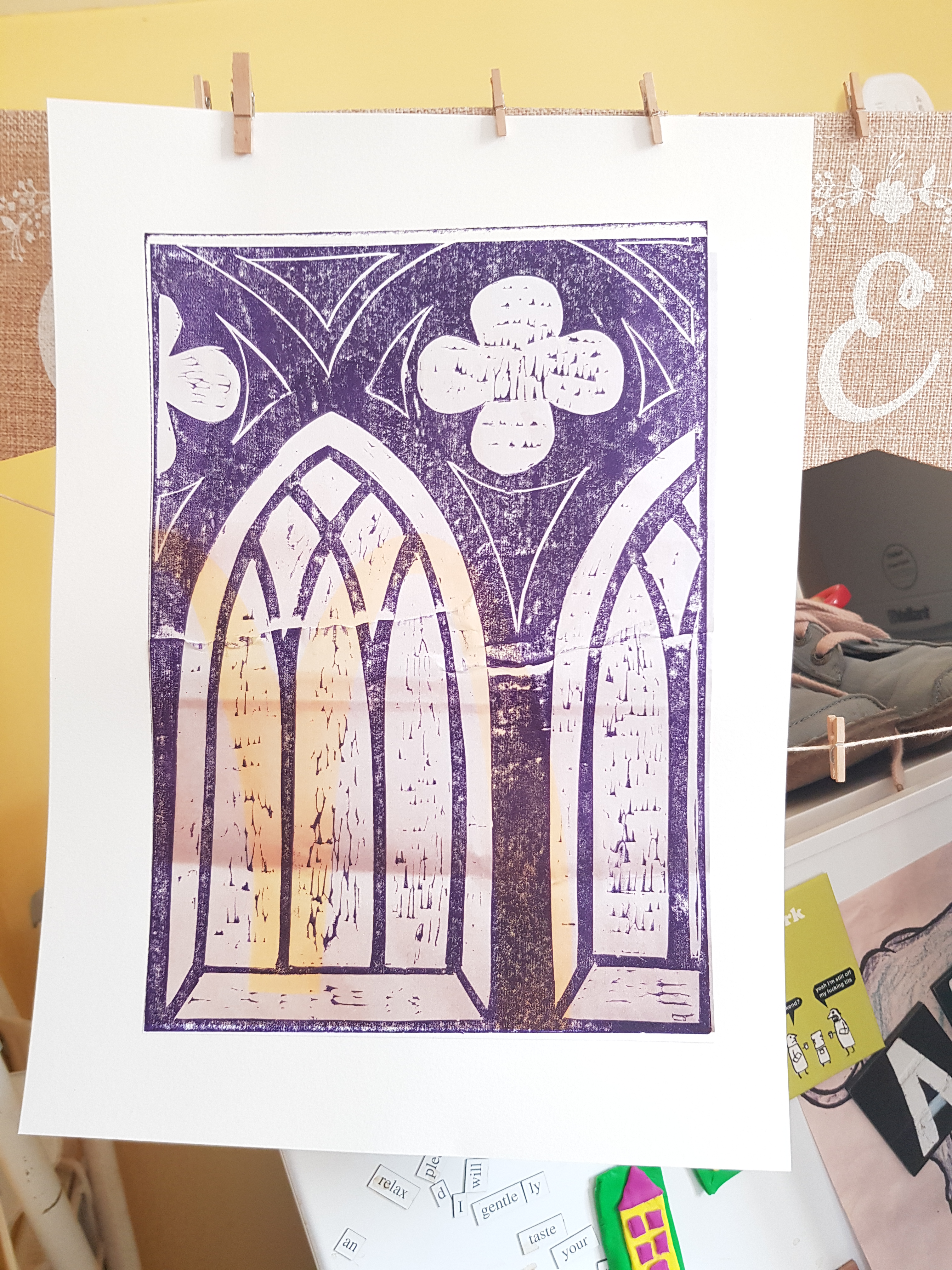
Inspired by Diane Croft’s prints of landscapes, I contemplated the growing pile of discarded delivery packaging in my studio, and decided to put the two together for this personal project, using the chine collé technique. A stained-glass effect in Croft’s depiction of trees caught my eye, leading me to use the image of a church window to symbolise an historical element in this print series.
“…and he shall have dominion…”
I have set out to say something about the gradual erosion, over millennia, of a sense of personal responsibility around the sourcing of food, particularly meat and meat products. From the time we were hunter-gatherers and presumably had respect for the ebb and flow of supply, until now, when we have merely to ask Alexa, and 30 mins later it is served up at the door on a bed of pizza dough or within a burger bun, what has happened? Our brains and bodies haven’t evolved particularly, but we have moved into a technological age. This technology was developed with the best of intentions: to serve a purpose; to aid humanity.
“One Click Smile”
This subject is highly personal to me, as it is about food and online ordering. It would not be overstating things to say I have addiction issues. Middle of the night binge-eating and secret solo shopping trips, each internet-reliant, are not unusual. And I know I am not alone in being alone.
The beaming Amazon packaging of “One Click Smile” is juxtaposed with a chine collé linocut print in the shape of a set of church windows. Through these windows can be seen two hearts. Green with envy, they implore us to “Choose me, use me, recycle me.” It’s as though this is a church mantra, a hymn for our time. We have allowed ourselves to become hypnotised by advertising in the same way we once accepted the rule (and rules) of religion. Formerly people were under-educated; now we suffer overwhelming information overload. It’s hard to filter it out; to focus on what actually matters.
I seek to comment on the fact that we are divorced from our natural environment. Addiction to mobile technology and online activities have replaced community and any genuine connection. We crave yet more of the same damaging habits, thus proving one of the best-known definitions of madness. Something has to give.
Hopefully the Macdonald’s reference here is not excessive. I wanted it to look like a stained glass effect. There should be a realisation that it’s not a church at all but possibly an ad for a fast food restaurant. I’m suggesting that one has conveniently filled the void the other has left. Or indeed, it has barged it rudely out of the way.
I used a lot of paper today, possibly unnecessarily. The following are the also-rans of today’s work:
Less successful for various reasons pertaining to inking issues, paper placement issues, and poor composition of the separate chine collé pieces
I started this project by drawing spiral arrangements in my sketchbook. My thinking was to produce abstract designs for the final series of prints for this course unit.
I then went on to look at other people’s chine collé creations. This one, by Diana Croft, caught my eye. The archway suggested by the tree put me in mind of stained glass church windows. I thought I could have fun using different colours and patterns – including spirals.
Diana Croft
I produced a test plate with a basic church window, as follows :
Test plate
From this I produced my very first chine collé print:
Chine collé test print with tissue and textured paper
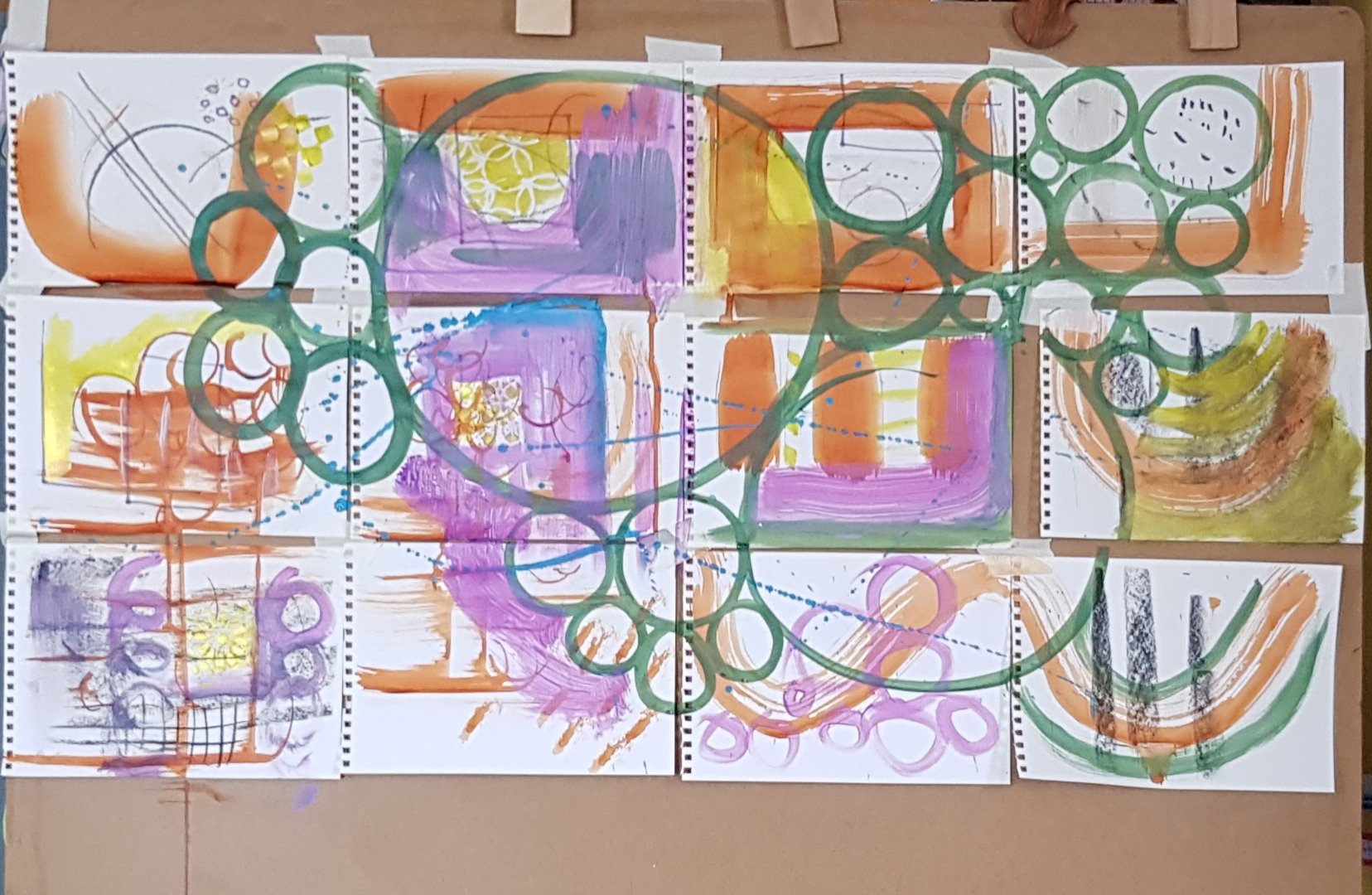
Enthused by this, I designed a slightly more complex image and went off to do something else for a while. That “something else” was, among other things, to dabble further in abstraction. I spent a few minutes following an online video on the subject of abstract painting by Tracey Verdugo. I then created the following images using contrasting elements as inspiration:
Buoyed by this, I extracted some of the more interesting elements from the whole piece and printed them out on my Epson printer. I then used these, in conjunction with my test plate to produce the following using the chine collé technique:
The more complex plate has now been cut, though further cutting may be required. I took the following proof earlier today:
Proof using basic lino printmaking technique
I have been experimenting using packaging from Amazon, McDonald’s and Aldi products, as follows:
Hand prints on packaging in the style of cave dwellers’ art from thousands of years ago
It is my intention to try to say something relevant about how Mammon, and the new religion which is consumerism, has taken over from the church as the chief mind control system of the masses. This is not to say that I think it has been any one person’s brainchild, more that it has been a gradual takeover since the industrial revolution. I find it to be interesting how people accept this transition almost as though it hadn’t happened at all. The church has been all but usurped from its position of power over western communities. Instead, branding is the new power.
I shall print over the top of this packaging with my church plate using chine collé technique. If I mess it up, at least I can console myself by purchasing another Big Mac – purely to acquire further packaging for the purposes of experimental art, you understand.
I’ve been waiting on paper stock supplies so that I can print from my latest collagraph plates. Having made them a bit too large for my current paper stock, I ordered further heavy weight paper from Jackson’s. This has turned up today. So tomorrow, bright and early, I shall recommence proceedings.
The following plates are what I came up with in response to the abstract brief for Part 4 of Introduction to Printmaking. My initial intention to work with the themes optimism, movement, balance, and flow have morphed into those themes surrounding COVID rules and how we have responded to them. Instead, I have created plates entitled, “community”, “containment”, “control” and “contamination”.
Craft lolly sticks, bubble wrap and O rings
The above was developed from the sketch below on the facing page of my sketchbook.
My thinking behind this was about the organic nature of society and community. I likened it to the petals on a rose, only a bit more rigid in nature. The sticks are arranged sympathetically with one another to form a structure that is supportive, but also adaptable. The next plate was an attempt to create an image that depicts how it feels when patriarchal societies seek to exert control over the population.
“Control” plate with corrugated packaging and metal washers
I arranged the the above plate without prior need of sketches, as I had quite a clear idea in my mind of what effect I wished to achieve. I was pleased with the outcome below.
“Control” Print on damp 250gsm Fabriano UNICA printmaking paper 28cm x 38cm
The enforced rigidity of the movement of the circular motifs in this print call to my mind a metaphor for limited freedoms during COVID-19 and its various strains. Whereas, the following print taken from the plate for “Containment” is less rigid in structure. It appears to exist via faith alone, as its building blocks do not adhere to the more solid rules in the print called “Control”.
Containment
The next two images are plates at various stages of completion. I need to take prints from these to determine what to add or to subtract from them to depict “Contamination” and “Community”
“Contamination”
The above plate was inspired by the following doodle which I scrawled onto my iPad, printed off, then added to using biro and highlighter pens.
Sketchbook doodles inspiration for “Contamination”
The above sketch was in turn prompted from looking at images of the Delaunay bisected concentric circles with their rich colour juxtapositions. I shall enjoy playing around with my own colour choices now that my paper has turned up.
The following is another plate – a version depicting “Connection”. Here, I have used string to form the double spiral and metal washers to ‘populate’ them. The external negative space has been textured using poly filler and sand, and by pressing corrugated card into the surface whilst not yet set to give the surface small ridges.
“Connection” “Connection” printed on damp Somerset satin 300gsm printmaking paper
There is an inadvertent smiley face in this image. Appropriate or not, it is clearly visible. Perhaps re orientating it to landscape would eliminate this unfortunate effect:
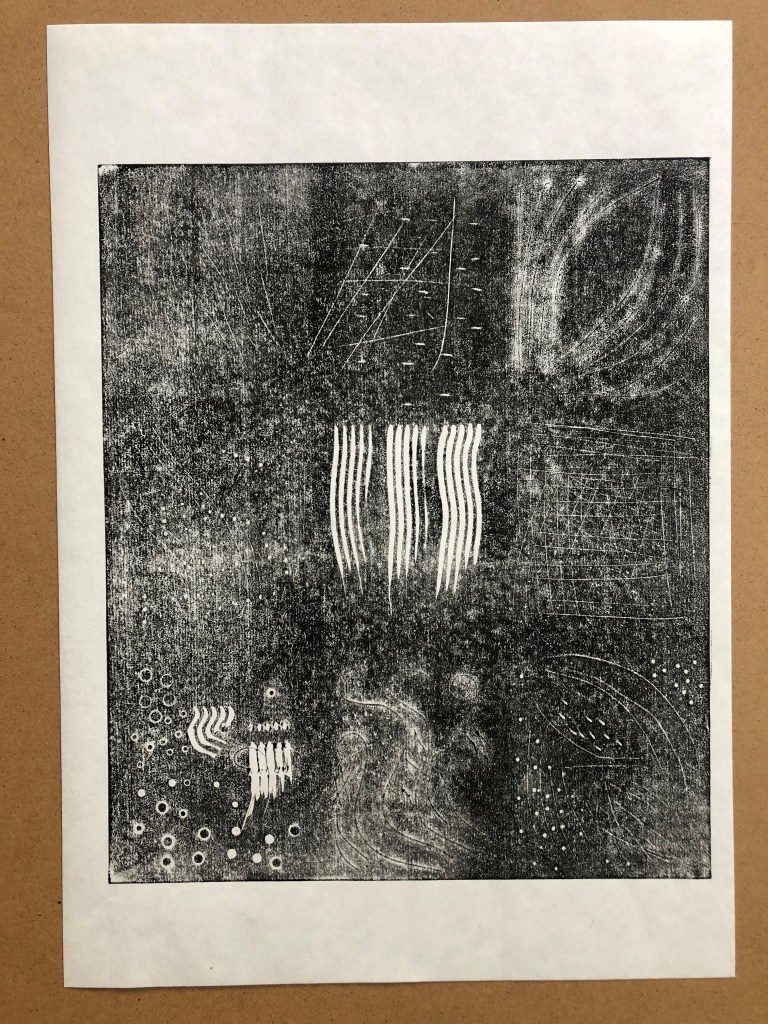
The following is entitled “Contamination” to continue with the theme of how the pandemic has affected social cohesion. There is something about the way the spiral holds both the occupants and contaminants equally within its organic structure.
Collagraph plate for “Contamination”“Contamination” print on Somerset satin 300gsm printmaking paper
The best (if not the only) way I can view, and try to understand non-representational art is to think of it as analogous to something else.
I attended half an online taster session in Art Therapy at the University of Hertfordshire a few months back. We were instructed to close our eyes and, with a pencil, try to locate the edge of a piece of A4 paper without going so far as to allow the point of the pencil to wander off the edge of the paper, and mark the surface of the table. Other people drew lines around where they perceived the edge of the paper to be, as though pacing a cell and surreptitiously checking for weak points . I attacked this imaginary boundary. When I was done, and opened my eyes, I saw an elongated, jagged edged shape on the landscape sheet of coloured paper. I interpreted this to mean that I was like some kind of rabid beast, hell-bent on escape from – exactly where?
The reason I recount this now is because I feel it illustrates my view of non-representational art. It’s like painting a tiger with your hands tied behind your back. (You can’t paint with your feet because you’re busy using them to run from the tiger!)
Flights of fancy aside, I do find abstract art interesting, if a little perplexing. So it is with some trepidation and with a spirit of adventure that I embark upon this latest project.
A1 test plate – prior to inking (Flipped then annotated)
So keen was I to take prints from my test plate, that I neglected to look at the directions in the course text. I went ahead and inked my plate using some scrunched fabric. Without dampening the paper, I took two impressions.
The resulting prints were a little as though a spider had wandered across the paper with dirty feet. However, I have, at least, learned that certain materials work more effectively than others. Not dampening the paper prior to printmaking led to weaker results, but it did at least tell me which materials were most impactful.
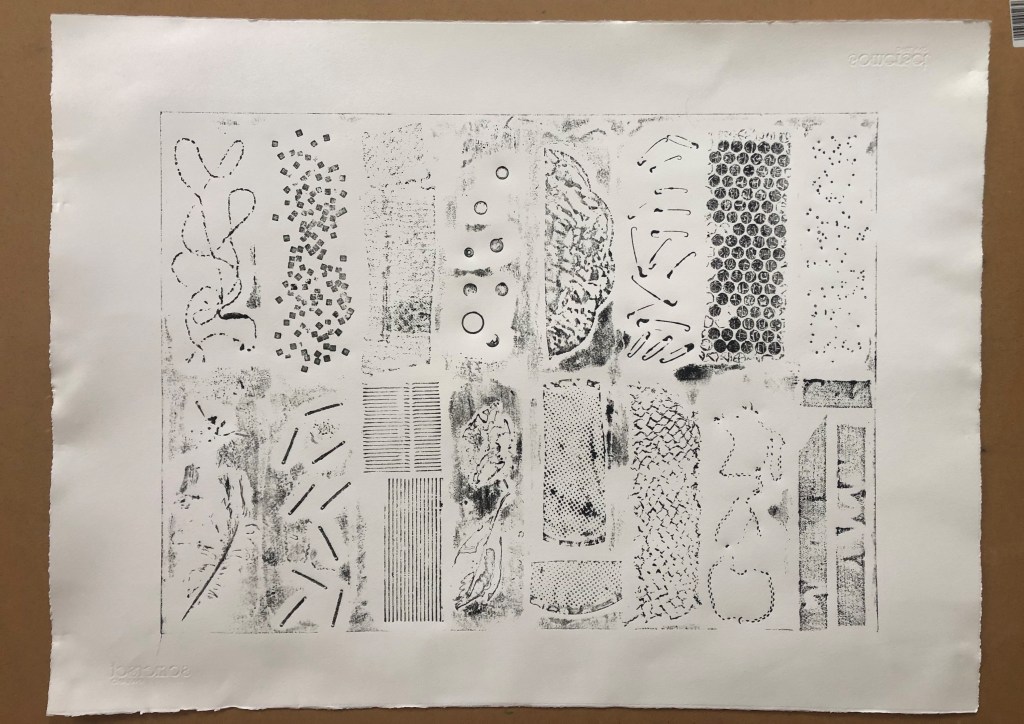
The following is the initial print onto dry smooth Zerkall 120gsm printmaking paper. I like this print. At least all items made some impression. The best effects came from the corrugated card, the bubblewrap and the mosaic tiles. I’m excited to move onto developing another plate – this time using a smaller piece of mountboard as the only paper I have that’s heavy enough to take dampening is my Somerset paper, which I have only in smaller pieces than the Zerkall seen below (54cm x 76cm).
Initial print
I think, with the next plate, I shall attempt a more interesting and cohesive composition, rather than redoing the test plate exercise. I intend to continue with the themes of optimism, movement, balance and flow.
Update:
The following day – feeling optimistic- I set out to rectify yesterday’s error and dampen the paper before printing. This was overly ambitious in scale as the Zerkall paper I have is not quite as robust as Somerset, for example. Therefore it buckled somewhat under it’s own sodden weight. However, I took two prints regardless, as follows.:
Print on damp Zerkall 120gsm with black oil based ink rolled onto the platePrint onto damp Zerkall 120gsm – black oil based ink pressed onto the plate
I’ll wait for the ink to dry before attempting to flatten the paper under some blotting paper and some form of weight.
Update (May 2021)
Test print on 56cm x 76cm Somerset 300gsm satin printmaking paper – soaked for 10 mins then blotted before printing
The above print is a lot clearer than former attempts using lighter weight paper – either dry or damp. I feel that the most successful items used here are the bubble wrap, mosaic tiles, beads, and corrugated card. I shall use these in further print plates for Project 12, the abstract composition.
Better late than never. It’s been a month or so since I received formative feedback on assignment 2. The main matters arising were as follows:
Matters Arising from (in no particular order) Introduction to Linocut
1)Transfer Blog to OCA Spaces for reasons of ease of navigation.
Although I initially agreed that this was a good idea, I realised that in order to do so I would need to use my OCA email address to link the content of my blog when thus transferring it. As I shall ultimately lose my email address at the end of my studies, I decided to remain with WordPress as it means I get to keep all of my work online.
2) Draw more often from source
This I have tried to do using objects that are around me such as cars and people in the park.
3) Do more research posts and make them overt so that they can be easily found on the blog.
This has been started, in that I have added the relevant category “Formative Feedback” and “Reflection on Formative Feedback”. I am finishing this task once this particular reflection piece has been completed.
4) Michelle was genuinely pleased and impressed by the quality and the quantity of Printmaking in evidence in my portfolio.
She gave me pointers on artists such as Edward Hopper, Vanessa Gardiner and Martin Lewis. She recommended mind mapping my decision making process on which life form to pursue during the following Part of the unit.
My next assignment is due 16th April 2021.
Summative Assessment will take place as intended in November 2021.
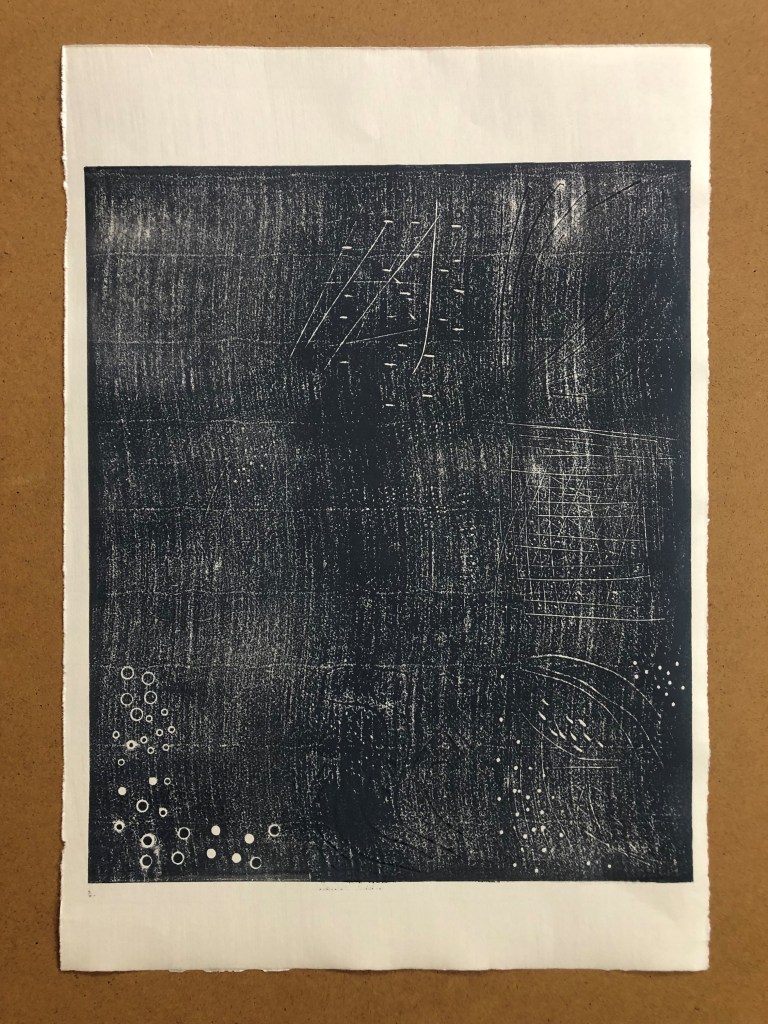
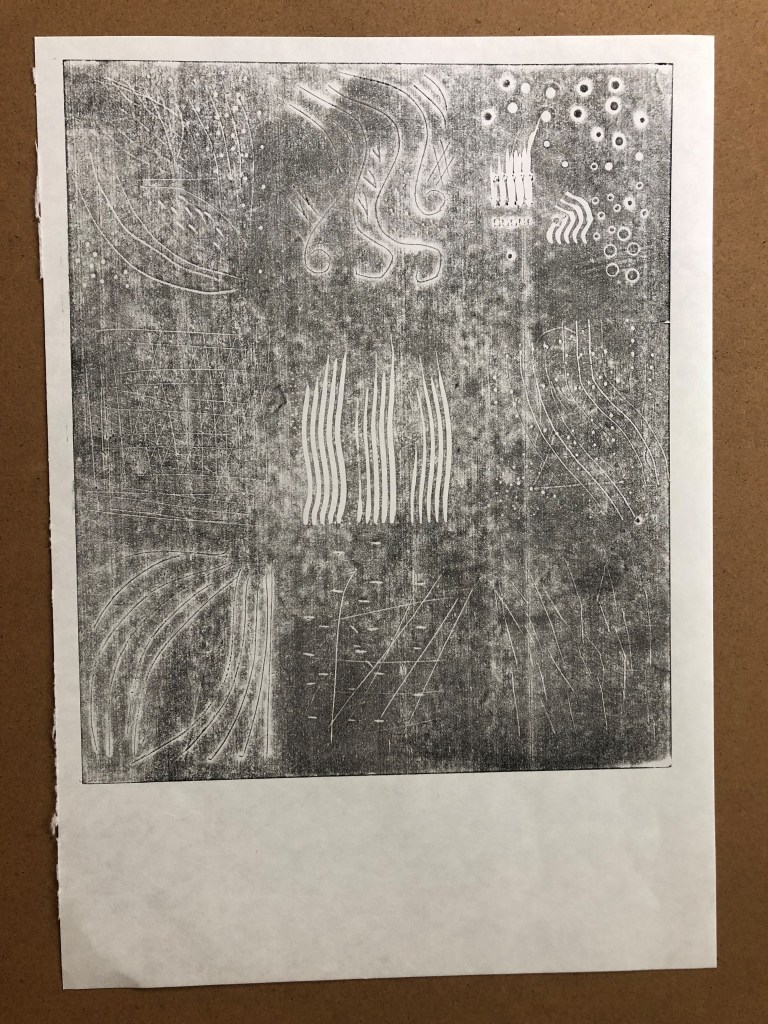
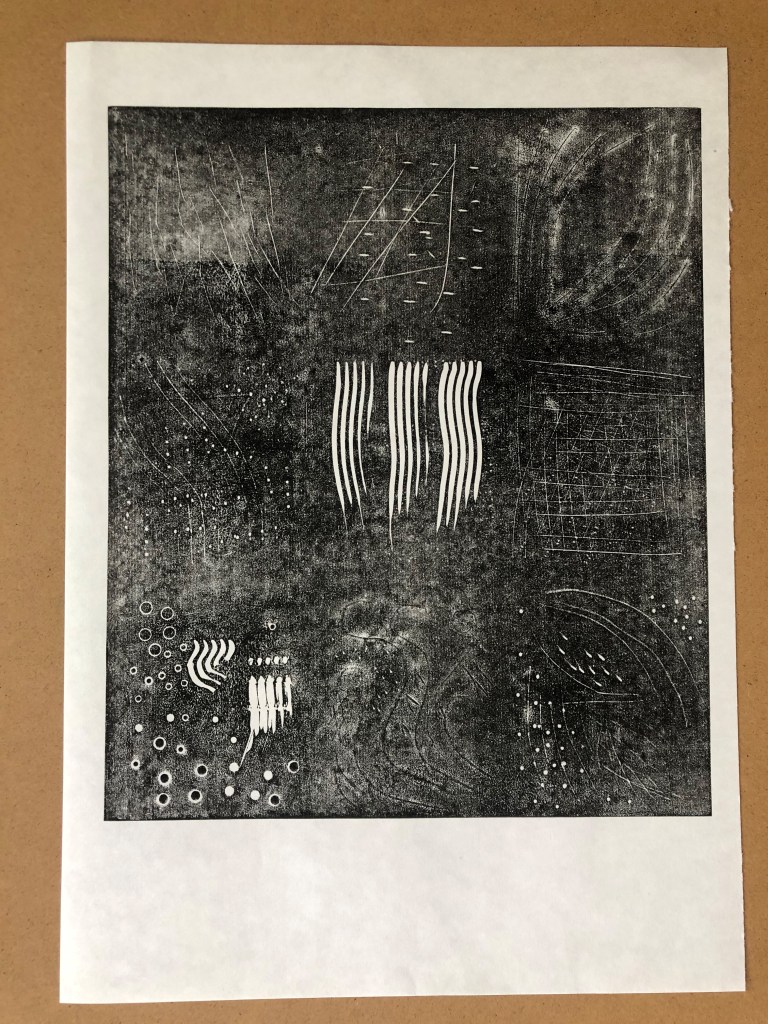
Hopefully, there are discernible squares marked out on this Lino plate. They were numbered 1-9 reading top down, left to right. The tools used to cut into, or at least to mark the the surface of the lino, are as follows.
Steel intaglio tool, double ended. I used both ends of this tool. I pressed both the end point and the side curve into the lino. I found that this created strong marks in the lino which in turn printed clearly lines and dots.
Exacto knife. This cut very fine lines, as perhaps one might expect from a sharp knife. The deeper the cut the more unwieldy this tool became so that my attempts at cutting curves into the surface of the lino became angular in nature. Post print these registered as dark lines instead of white as the cut marks simply filled with ink.
Hole punch and eylet setter tools. These two tools were limited in their reach beyond the edge of the lino. These could be used effectively as border tools perhaps. Maybe for the centre of a flower or a jewel? Post print these printed as clear and perfect circles or little eclipses (sic)
Tweezers. I wasn’t expecting a great deal from these. They make marks of parallel lines and indents by pressing the tips into the lino. Post print these made clear lines as part of the print.
“Thing“. My partner provided this item. I suspect it’s a drill bit of some kind. It’s a bit like a cylindrical mace. I was unconvinced that anything would show up in the final print, as I simply rolled this item on its side along the lino. Post print it did however just show up as a uniform series of white dots.
Pencil/pen. These were good for drawing onto the lino. When it came to printing they barely showed up at all. Using a biro I drew a simple figure which was not clear on any of the prints.
Hacksaw blade. This was satisfying to play with, making obvious score marks in the very top of the lino surface. I felt confident that the print would show these marks clearly, however, they were not as obvious as all that. They were ink-filled lines, so black on black.
Bulldog clip. Parallel lines like the tweezers – bit deeper. I turned the clip onto its edge and scored lines that show clearly in the lino. I then made dents with the corners of the bulldog clips. Post print these were clear white lines and dents in the print.
Sandpaper. This made nice highlighted areas on the lino but did not show up whatsoever on the print. I then used the edge of a Philips screwdriver to make bark-like impressions but these showed up in the final print as mere lines.
At first I suspected this exercise to be a waste of time, effort, resources and of my patience and personal safety in using blunt tools where well-maintained tools are prerequisite.
If planning to do any kind of lino cutting, you can’t really go too wrong with a set of decent lino cutting tools. Rather than attempting to reinvent the wheel using a fork or a knife, for example, what’s wrong with simply investing in a good Pfeil set?
However, I persevered. I tried stabbing the lino with a fork and dragging a Philips screwdriver along the surface of the lino. This did not change my view, until I tried to cut using a zester.
I made several marks using this tool from my partner’s kitchen. As well as this, I used a standalone hole punch which, by simply pressing the tip into the lino, cuts satisfyingly perfect holes every time, and wherever you wished to place them.
I used Somerset White 300gsm paper, Hosho paper, and Zerkall 120gsm for this project. I have not varied the ink colour particularly. I was attempting to gain a clear representation of the plate by varying the amount of ink I applied rather than varying the colour.
Strangely, the best representation of the lino plate in print form has been by using the lightest touch with black ink. Each of the cuts in this instance are clearly visible on the lightly inked print. I intend submitting one other pre-zester print just for completion.
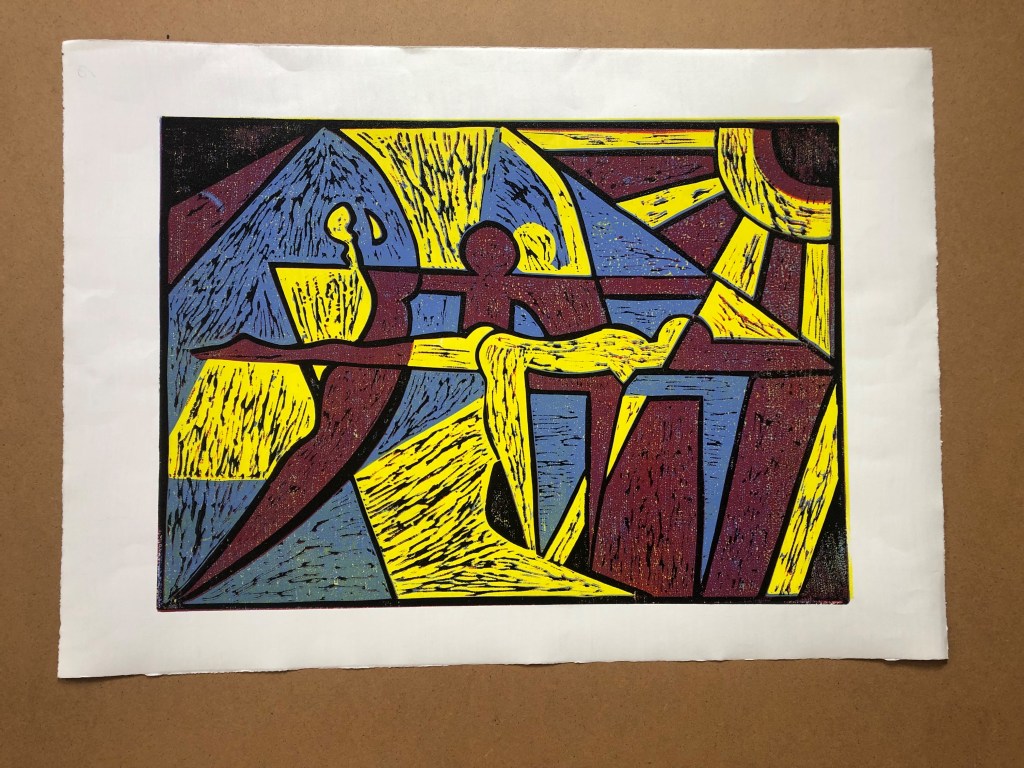
Over all I am fairly pleased with the outcome of this first reduction print. There is not much I’d do differently. Perhaps I’d be a little less concerned about inadvertently creating lascivious outcomes and stick to my original design and do less designing “on the hoof” so to speak. I was thinking in particular about the area immediately behind the central figure whose leg is extended. My concern was that she appeared overly exposed, but feel my prudishness may have had the effect of rendering the central figure behind her a little off balance as I removed a block that would otherwise have been darker in colour and so she appears to have only one leg to stand on. This hasn’t spoiled the composition though, as it is quite abstract in nature, as was my intention.
I think that it’s okay to react to how the design actually looks on paper once printed. On the whole, designing at the outset and then sticking to a plan is probably best. But the nature of printmaking is that outcomes are not always so predictable. It is tempting to change one’s mind part way through and make adjustments accordingly.
I am happy with the effect of the residual cut marks being in different directions which implies movement to the scene. It also has a furry quality which I may use in the next exercise.
My thinking behind this design was to create something of an homage to the poster designs of the roaring ’20s. In creating this piece, I am satisfying my need to bring a sense of hope to the viewer. The themes of optimism towards the future of human interaction (in the current COVID climate) speak of a new attitude. Being that bit older than the average student, I am aware that human experience involves peaks and troughs – not only as individuals, but as a species. I think an atmosphere of devil-may-care may prevail again, just like that brief spell of respite between the two world wars. My hope is that this will not be quite so short-lived. I look forward to a time when people will come together in groups once again to celebrate life, health, and a sense of mental well-being, with all the benefits that has to offer.











 Maureen Walker's Introduction to Printmaking Blog