Research Point: Corita Kent, Robert Rauschenberg, and Ed Ruscha

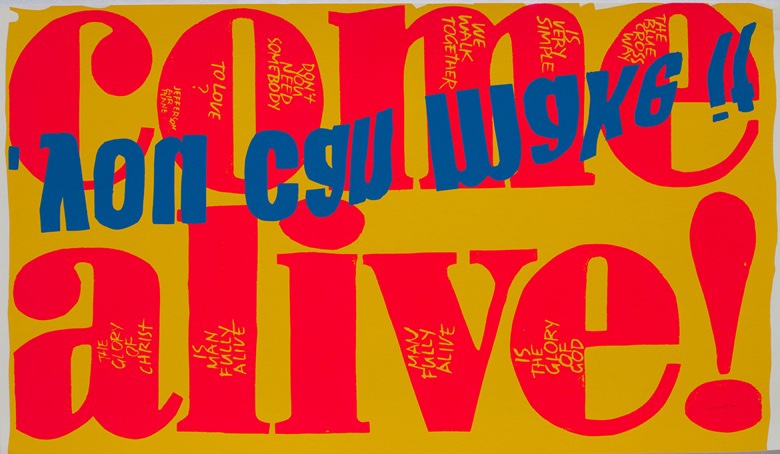
Corita Kent

Corita Kent’s prints are reminiscent of fast food packaging. Her work puts me firmly in mind of graphic art used as marketing for fast food and other types of packaging used for everyday items. It is eye catching and seeks to convey a spiritual as well as a social- political message. I was not certain whether these pieces were the result of collage or of printmaking, or a mixture of the two. I feel compelled to emulate the way she has used silk screen methods to create these messages, as she is using popular advertising methods to communicate age old ideas about faith and spirituality. Though my message would be less spiritually inclined, the spirit of spontaneous goodwill these pieces convey is hopefully contagious.

Robert Rauschenberg

Erased de Kooning Drawing, 1953
Traces of drawing media on paper with label and gilded frame

Defacing another artists work, and calling it art? Hmm, not sure I approve of that. But I suppose that’s the point. As a publicity stunt it’s been rather effective for Robert Rauschenberg, as people are still discussing this subject today.

Ed Ruscha

Ed Ruscha: Standard Station, Amarillo, Texas (1963)

With its cean, unfussy lines of minimalist architecture this painting conveys so much more than a simple service building. It evokes an era of American popular history. You can almost hear the 1950s car engines as they cruise by, all winged fenders and exaggerated curves. It also speaks of the similar treatment of advertising campaigns at the time. I can almost feel the baked tarmac melting in the sun.

References:

Ed Ruscha: Standard (2021) LACMA. Available at: http://www.lacma.org/art/exhibition/ed-ruscha-standard (Accessed: 5 July 2021).

Erased de Kooning Drawing (2021) SFMOMA. Available at: https://www.sfmoma.org/artwork/98-298/ (Accessed: 5 July 2021).

“The grandmother of socially active art”: the generous work of Sister Corita Kent (2021). Available at: https://www.itsnicethat.com/features/corita-kent-ray-smith-art-international-womens-day-080318 (Accessed: 5 July 2021).

RA Hockney Exhibition: The Arrival of Spring, Normandy, 2020

I’m glad I didnt read the reviews prior to going to see this exhibition of sketches by David Hockney. If you accept the work for what it is – a series of sketches – rather than as finished outcomes in themselves, then it is easier to come away from this exhibition with a feeling of something approaching satisfaction.

Unlike the Tracey Emin/Edvard Munch exhibition, photography was forbidden on this particular occasion. Where the former was light on content but heavy on subject matter, this was quite the opposite. The subject of the emergence of spring in a French garden in 2020 was, for me, an exciting prospect, given Hockney’s reputation for colour use. However, the colour choices made, I felt, were limited by the method/medium used, in this case an iPad. I’d usually see the digital approach as one favoured by graphic artists. But it’s not out of the question to use it as a primary mark-making tool. But, you’d better know how to get the best effects in order to be successful in your outcomes. I’m not sure that David Hockney has in this case. The fact that they are sketches on an ipad that have then been blown up far beyond their original size and placed in such an environment – one associated as representing the upper echelons of the art world, does not improve the effect of these images on the viewer. Rather than working as an enhancement of the reputations of either the Royal Academy or of David Hockney, this exhibition sadly represents a demotion of both. I searched desperately for signs that one of my favourite colour artists had not lost his touch. I was searching in vain.

However, on the train home, we googled reviews of the show. Perhaps unsurprisingly they were pretty scathing. One did mention that they had seen recent, more traditional, evidence of the artist’s drawing skills using pen and ink. It was with a heart warming feeling, and no small sense of relief, to learn that his talent is still very much alive and kicking.

References:

David Hockney: The Arrival of Spring, Normandy, 2020 | Exhibition | Royal Academy of Arts (23rd May – 26th September). Available at: https://www.royalacademy.org.uk/exhibition/david-hockney (Accessed: 30 June 2021).

Emin/Munch: The Loneliness of the Soul

I was excited about going into London to an actual physical gallery exhibition at the Royal Academy.  I wasn’t expecting to be overwhelmed by visual stimulation within 15 minutes of arriving, though. It was as if I’d used up my mental viewing credits for the entire month within moments of seeing my first red-splattered Emin canvas. My first thought was that there had been too few Munchs included in the exhibition.  But, as I walked around the small space – blissfully uncrowded by other visitors – I realised it had been well curated by Edith Devaney  The subject matter of raw emotion by these two artists leaves me emotionally affected.  So much so, that this bite-sized exhibition is just “on the money” as regards the quantity of pieces displayed. I’d been feeling a little jaded from a sensation of “the morning after the night before” (we visited the gallery on a Sunday afternoon) so, the splashes of red juxtaposed with green in both artists’ work had even more impact than on any week day, for example.

Tracey Emin. 2018. “It was all too much”. Oil on canvas

This exhibition spoke to me of the distress, not only of loneliness, but the confusion that is felt in the midst of post traumatic stress and depression. Having listened to an excellent Woman’s Hour interview with Emin on the subject of the exhibition,  as well as reading about it afterwards in “A Guide for Friends” handed out on entry, it brings it home to me again, the importance of context,  especially in contemporary fine art.

“Being an artist isn’t about making something beautiful,  let the designers make something beautiful. Our job as an artist is to battle with the soul. Sometimes we lose, but that’s what it’s about.” (Emin. 2021)

Reading this quote having just made the decision to move from a fine art discipline to one of illustration,  I feel something of having let myself off the “suffering artist ” hook. It is less necessary to “bleed” onto a canvas as an illustrator.  This leaves me feeling somewhat relieved. Rather than feeling deprived, it is as though I have escaped some future traumatic journey. Self discovery needn’t be quite so public, I feel. Though I appreciate it immensely when others take pains to do so, as Emin has done with this exhibition.

Edvard Munch. “The Death of Marrat”. 1907. Oil on canvas

ED asked “Do you see painting as the ultimate creativity?”

TE “Totally. I really love the fear of the canvas, the fear of the moment of beginning.  There are a lot of painters that work with grids, with projectors, with photography, or other people do the paintings for them. I’m not talking about that, I’m talking about the cave woman. I’m talking about the last woman on earth making a message.” Emin. 2021.

I love that reference to cave woman. It puts me in mind of my subject matter for the part 5 personal project, for the printmaking module, using chine colle. Cave painting will be a feature, I’ve just decided. I’m not certain how. But it’s definitely in there. What I have so far relates to commercialism as a new religion to control the masses. I’m thinking of a stained glass window effect using chine colle, but depicting, in place of the usual bible stories with saints etc, I will use images of cave painting and/or women involved in this activity.

References: 

Edvard Munch (1907) The Death of Marrat.

Royal Academy (2021) Tracey Emin / Edvard Munch | Exhibition | Royal Academy of Arts, Royal Academy. Available at: https://www.royalacademy.org.uk/exhibition/tracey-emin-edvard-munch (Accessed: 24 May 2021).

Tracey Emin (2018) It was all too much.

Tracey Emin (2021) ‘Emin/Munch The Loneliness of the Soul’. Available at: roy.ac/iamafriend (Accessed: 23 May 2021).

Woman’s Hour – Weekend Woman’s Hour: Tracey Emin; Susan Rogers, Prince’s sound engineer; Panic attacks – BBC Sounds (no date). Available at: https://www.bbc.co.uk/sounds/play/m000vwsl (Accessed: 8 August 2021).

Peter Wray, Gary Hume, and Dale Devereux Barker

Peter Wray

Half forgotten Voice. Peter Wray

Music is a major influence, especially Irish traditional music with its melodies providing a counterpoint for all kinds of musical adventures that underpin and are held within it. I love to explore the question – what is important: the dominant melody or those qualities that contain it or are contained within it? There is no such thing as “just a tune”, as there is no such thing as “just a drawing”’. (Wray. 2005)

The above quote rings familiar with me, as I too enjoy playing Irish music on my violin. I can see something of the gritty quality of the music in Peter Wray’s work. However, the work and the quote came simultaneously to me, so I’m uncertain as to which one initially influenced the other in my mind. Despite this, the texture of the work inspires imitation or future homage.

Gary Hume

Yellow Slip. Gary Hume

“These prints are inspired by recent paintings but after addressing formal issues such as colour, tone and line, they take on their own trajectories, qualities and personalities. It is therefore important to engage with the process to make the most of the opportunity to offer something fresh and beautiful.” – (Gary Hume. 2017)

I think, in saying the above, the artist is communicating that, similarly to when a book is written as a screenplay, fresh qualities emerge once a different process is used to develop the same or similar subject matter. I can imagine this image in 3D as a sculpture in clay or in bronze. It illustrates the importance, and the value, of investigating subjects through varied mediums.

Dale Devereux Barker

Connected. Dale Devereux Barker

The Bankside Gallery says of Dale Devereux Barker, “Since graduating from the Slade in 1986 he has developed a pictorial language which is distinctive in its combination of figurative imagery and complex layering of more abstract planes and textures scavenged from outside sources.” (Bankside Gallery Website).

I interpret this to mean that he doesn’t just make the shapes up in his head, but draws from the real world objects as well as the all important spaces between them. His artistic voice is established and recognisable to those who have experienced his work. I shall be looking out for it in future as I would be proud to list him amongst my influences.

References:

Dale Devereux Barker (2021) Dale Devereux Barker RE – Biography, Bankside Gallery. Available at: https://www.banksidegallery.com/artists/359-dale-devereux-barker-re/biography/ (Accessed: 17 May 2021).

Pyramid Gallery (2005) Peter Wray. RE Autumn Exhibition, Pyramid Gallery. Available at: https://www.pyramidgallery.com/B-sept05.htm#Work (Accessed: 17 May 2021).

Royal Academy (2017) Gary Hume RA: Prints Pictures | Exhibition | Royal Academy of Arts. Available at: https://www.royalacademy.org.uk/exhibition/art-sales-gary-hume-ra-print-pictures (Accessed: 17 May 2021).

Louise Bourgeois: Spirals

Spirals 2005 Louise Bourgeois 1911-2010 ARTIST ROOMS Tate and National Galleries of Scotland. Lent by the Artist Rooms Foundation 2013 http://www.tate.org.uk/art/work/AL00346

I return to Louise Bourgeois’s work as a reference point for the use of spirals in my own work. I have used this symbol as a way of presenting my ideas about community and society in general, from the micro, rose petal pattern, to the macro level of representing a sense of community, rather than as symbols representing themes surrounding personal relationships, as Bourgeois has done.

In the Tate article the word “Control” (Tate. 2005) is mentioned, but rather than in respect of being the one under control, Bourgeois sees the spiral as representing her own sense of having control. In that respect it is a more subjective use of the symbol – presented here in the form of a grid. The minimalist use of primary colours gives them additional impact. I may consider using this device in my own presentations in future.

References:

Tate (no date) ‘Spirals’, Louise Bourgeois, 2005, Tate. Available at: https://www.tate.org.uk/art/artworks/bourgeois-spirals-al00346 (Accessed: 15 May 2021).

Part 4: Abstract Art: Research Point

Wassily Kandinsky

Color Study. Squares with Concentric Circles. Wassily Kandinsky (1913)

The above image, though not a finished outcome in itself, is readily recognisable as the work of Wassily Kandinsky. You can see the texture of the watercolour paper where the artist used a sketchbook to work out different colour combinations as a reference tool for later works. I can imagine this was a most useful piece of work: time well spent in researching how different colours worked against, or with, one another when seen together like this. It is a great example of how preliminary work is an important part of the process, and that rushing headlong to the finished article is seldom an optimal way to produce art. I will take from this the lesson to work up to a finished outcome using a sketchbook and to play around with colour and form. This, as well as useful and pertinent note-taking, will further enhance the effect of my outcomes as well as my process.

Mark Rothko

No 5 – No 22. Mark Rothko. (1950)

Mark Rothko is another artist obsessed with colour combinations. He used thin layers of different coloured oil paint to produce luminescent outcomes on huge canvasses. When hung in galleries and viewed, these outcomes produce, in me anyway, certain emotional responses, speaking directly to one’s subconscious. This is perhaps not surprising, as Rothko himself is reputed to have said that “Art, to me, is an anecdote of the spirit”. Seen here on this tiny screen the full import of these works is hugely diluted. As with so many works of art, you have to be there to fully experience the intended effect.

Jackson Pollock

Summertime: Number 9A 1948 Jackson Pollock 1912-1956 Purchased 1988 http://www.tate.org.uk/art/work/T03977

There was method aplenty in Jackson Pollock’s “madness” here. The results of his famous drip technique are seen above. Again, the scale of this image has not translated well to a computer screen. A visit to the Tate to fully experience this piece is advisable. It speaks to me of graffiti art. There is a haphazard pattern in the movement of the punctured paint can as it deposits its contents over the canvas. This rhythm is analogous to the rhythm of life itself, or as its title says “Summertime”, the pattern is reflective of the seasons. Punctuated with primary colours, the black splashes are almost like an overly stylised font which attempts to communicate the unintelligible. It’s a fun, chaotic pattern, if that’s not too much of an oxymoron.

References:

Green and Maroon by Mark Rothko (no date). Available at: http://www.markrothko.org/green-maroon-1953/ (Accessed: 17 April 2021).

Jackson Pollock: 100 Famous Paintings Analysis and Biography (no date). Available at: https://www.jackson-pollock.org/ (Accessed: 17 April 2021).

Mark Rothko | Artnet (no date). Available at: http://www.artnet.com/artists/mark-rothko/ (Accessed: 17 April 2021).

Mark Rothko | MoMA (no date) The Museum of Modern Art. Available at: https://www.moma.org/artists/5047 (Accessed: 17 April 2021).

Tate (no date a) Jackson Pollock 1912–1956, Tate. Available at: https://www.tate.org.uk/art/artists/jackson-pollock-1785 (Accessed: 17 April 2021).

Tate (no date b) Wassily Kandinsky 1866–1944, Tate. Available at: https://www.tate.org.uk/art/artists/wassily-kandinsky-1382 (Accessed: 17 April 2021).

Wassily Kandinsky – 610 artworks, biography, books, quotes, articles (no date). Available at: https://www.wassilykandinsky.net/ (Accessed: 17 April 2021).

Aubrey Beardsley: Research Point

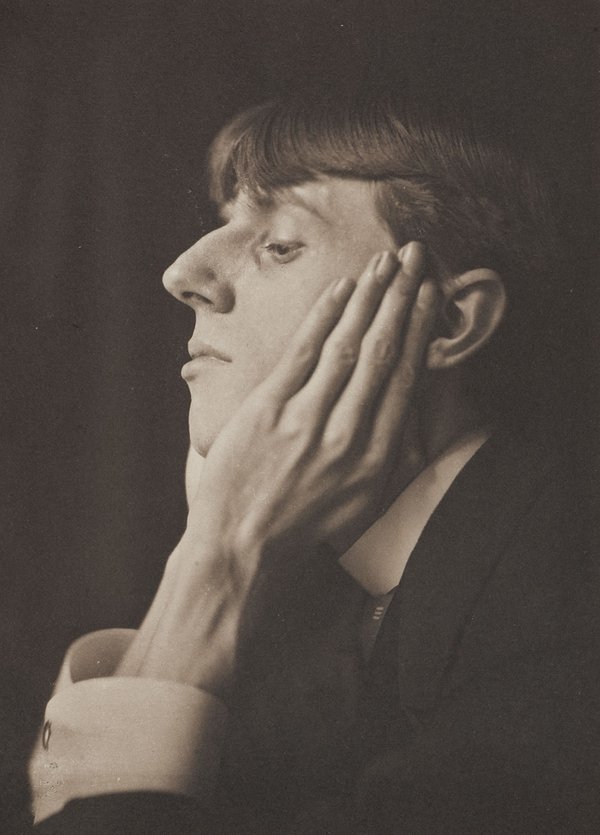
In a career that spanned just 6 years and ended at a mere 25 years of age, Beardsley produced more than a thousand drawings.

Photographic print processes appeared to rise up to the challenge of doing justice to his work. A zinc line block process faithfully reproduced the seas of black ink intertwined with complementary tendrils of white. These formed stylised representations of the human form engaged in the heights of emotional ecstasy as well as the depths of what some might term depravity.

Beardsley, a man of independent fortune, appeared to be free to roam with his visual depictions of the overtly sexual human form. There seems to have been little in the way of societal prohibition through which to curb his fantasies and therefore effect his outcomes. Perhaps with no ‘master of the wallet’ to dampen his soul and keep the reins taut, Beardsley allowed himself to run creatively amok.

Self Portrait (1892) Aubrey Beardsley

References:

Calloway, S. et al. (2020) Aubrey Beardsley. London: Tate. Tate (no date)

Aubrey Beardsley – Exhibition at Tate Britain, Tate. Available at: https://www.tate.org.uk/whats-on/tate-britain/exhibition/aubrey-beardsley (Accessed: 8 April 2021).

Vanessa Gardiner: Research Point

I thought that these images had been produced by some kind of printmaking method. I did not realise that they were acrylic paintings on board. They are highly reminiscent of early, and rather clumsy, attempts at representing landscape in computer animated simulator machines devised for the purpose of training pilots how to land helicopters and the like in dangerous situations and environments.

City Wall (2018) Vanessa Gardiner
Trevalga (2018) Vanessa Gardiner

I don’t really know what else to add to my comments on these works. I think I approve of the fact of their minimalism. The colour choices are in keeping with the natural world of landscapes, but I wonder whether a more urban subject matter may enhance the effect of the chosen medium/method. A few colourful buildings and even a few figures sprinkled about? But then the artwork, and what it sets out to achieve would be transformed. Perhaps that’s not the artist’s aim?

I confess to not knowing what the artist intended. A minimalist outcome has been achieved. But has anything been added by reproducing very similar images using the same method other than the obvious increased quantity?

References:

says, M. von D. (2012) ‘Vanessa Gardiner’, Sladers Yard, 6 August. Available at: https://sladersyard.wordpress.com/vanessa-gardiner/ (Accessed: 3 April 2021).

Thackeray Gallery (2017) VANESSA GARDINER | Thackeray Gallery, London. Available at: http://www.thackeraygallery.com/vanessa-gardiner (Accessed: 3 April 2021).

Edward Hopper: Research Point

Due to its atmosphere of impending drama, this aerial view Night Shadows (1921) could easily be a panel from a graphic novel. This evokes a feeling of mystery unravelling before our eyes. There is plenty of scope for the later addition of thought bubbles etc as the character in the hat considers where he has just been or where he is ultimately headed.

Night Shadows (1921) Edward Hopper

In 1923, after winning two prizes for etchings he had produced between 1915 and 1923, Hopper turned his attention back toward painting once more. The output from this was in turn influenced by his subject choices and compositions used for his etchings. I feel his work was over all influenced by the severe contrast necessary to produce outcomes with impact whilst printing using only black ink. These stark images speak of urban stories untold.

Night on the El Train (1921) Edward Hopper

Here is what could easily be interpreted as either a representation of a couple about to be engaged in an embrace whilst travelling by night on a train, or an innocent and unsuspecting man being cornered and harassed by a strange woman. The atmosphere created by the composition hints equally at either narrative. Again, a caption would not not be out of place here.

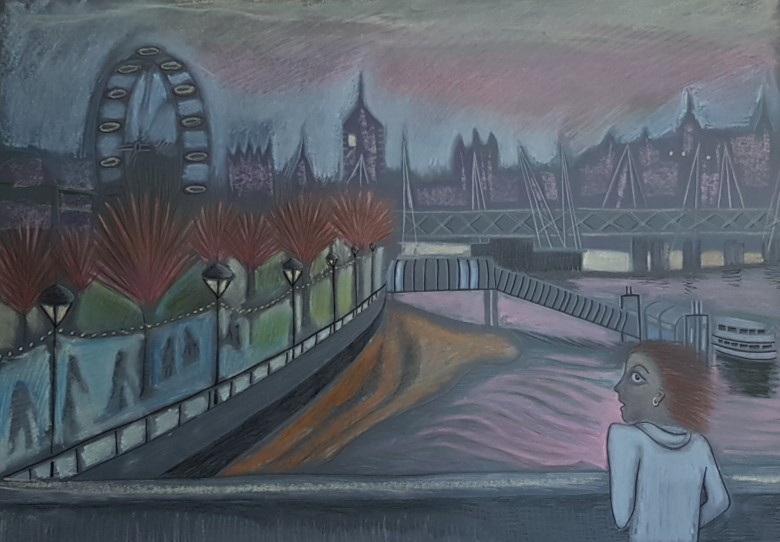
Again, I refer back to my composition, Waterloo Sunset (2020) to show that these influences have made their mark, even if I was not aware of these artists at the time, their output is not unfamiliar to me from browsing online and from magazine articles on printmaking etc.

Waterloo Sunset (2020) Maureen Walker

Landscapes such as these, once the addition of a figure or two has been made, become stories in the making as we ask ourselves, What? When? Who? Where? or Why?

References:

Edward Hopper | House Tops (2021) The Metropolitan Museum of Art. Available at: https://www.metmuseum.org/art/collection/search/366214 (Accessed: 5 April 2021).

Edward Hopper | Night on the El Train (2021) The Metropolitan Museum of Art. Available at: https://www.metmuseum.org/art/collection/search/366215 (Accessed: 5 April 2021).

Edward Hopper | Night Shadows (2021) The Metropolitan Museum of Art. Available at: https://www.metmuseum.org/art/collection/search/366206 (Accessed: 5 April 2021).

Martin Lewis: Research Point

The Glow of the City (1929)

The Glow of the City. (1929) Martin Lewis

There’s something about this image that speaks, screams of the seedy underbelly of a city by night. The fact that there is line upon line of washing hanging out to dry, places this piece in a time before the pervasive hum of the tumble drier seeped through the walls of one’s high rise flat and directly into one’s subconscious.

Across the gardens we can see that all the lights are on in the windows. Judging by the dated clothing worn by the figure in the foreground, this is somewhere between the wars. But, of course, the date of the piece (1929) kind of gives the game away.

This piece illustrates the hours following having worked fingers to the bone. Whether that be at the coal face, or at the punishing front line of typewriter keys, the result is much the same. There is a feeling of sweat and tears about this image. The level of tonal contrast together with the composition – the foreground figure taking up about a third of the space from the left, and the buildings in the background using up a third of the horizontal plane. It puts me firmly in mind of my drawing “Waterloo Sunset” due to the figure in the foreground being mirrored by my figure on the bridge.

Waterloo Sunset. (2020) Maureen Walker

However, where my figure is isolated by the scene and appears vulnerable, Martin Lewis’s female figure, whether she likes it or not, seems to be very much at home, or at least resigned to the fact that she is present in her home environment.

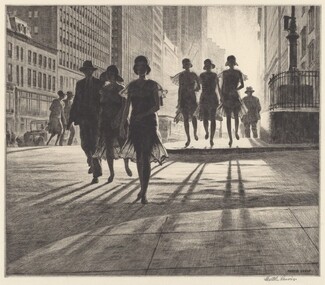
Looking at his other works it is clear that Martin Lewis was a huge fan of the long shadow. Here is a good example.

Shadow Dance (1930) Martin Lewis
Morrison’s Crowd (2020) Maureen Walker

References

Martin Lewis (2021) National Gallery. Available at: https://www.nga.gov/collection/artist-info.4704.html (Accessed: 3 April 2021).

Maureen Walker (2020) ‘Maureen Walkers Blog’, Part 4: Project 5: Groups of Figures. Available at: https://aphroditespace3.home.blog/2020/04/27/part-4-project-5-exercise-2-groups-of-figures/.

‘Assignment 3: Waterloo Sunset: Amendment’ (2020) Maureen Walker’s blog: An Artist’s Journey, 4 April. Available at: https://aphroditespace3.home.blog/2020/04/04/assignment-3-waterloo-sunset-amendment/ (Accessed: 3 April 2021).