Project 10 (Task 3) Research Point: Paul Catherall: Down and Out in Paris and London

Paul Catherall Down and Out in Paris and London (2013)

I have tried to work out how Paul Catherall has achieved this lino cut which, to me, feels strongly reminiscent of cubist works by Georges Braque and Pablo Picasso. I have no idea whether George Orwell, the author of the book Down and Out in Paris and London, for which this image is the cover design, was an aficionado of Absinthe-fuelled meanderings in amongst the narrow streets of Montmartre. I haven’t read the book. However, this is how it makes me feel and think as a view this image. Even the colour of the ink used hints at the wicked green fairy. It does at least make me curious about the contents of the book.

The clean lines and overlapping colours suggest the character of both cities viewed through a slightly skewed lens. This is the image that first prompted me to revisit an earlier sketch I had produced during the previous unit Drawing Skills. My approach to this image, of several women engaged in yoga warrior poses, had been inspired by the work of the cubist movement. I had first experimented with layers on my multi-colour linocut in the previous part of the intro to Printmaking unit. Paul Catherall’s work was very much in mind as I designed and cut the lino for Bottle Alley. I then used his work as a springboard to start a larger scale image for the theme of Life Form with several figures.

Paul Catherall’s image is a consistently skewed view without any figures present. My image of Yoga Warrior Poses is a little confused by comparison. Limbs intermingle. Some of my figures appear to have essential limbs completely missing, whereas others have more than their fair share. Also, I feel I have produced something with inadvertently salacious undertones in that the figure on the left appears to be about to strike the bared and vulnerable rear of another, more central figure. I have spent too much time on this, however. Although the outcome is not ideal, it does have some interesting shapes and colour combinations.

Since starting this reduction lino cut, I have reviewed my degree pathway choice. I have been transferred from the Drawing Pathway to the Illustration pathway. While I take both seriously, I feel myself breathe a huge sigh of relief in the fact that Illustration feels so much more apt to my approach to mark making. To me, art should be a fun activity. Art with a capital “A” always appears to be so serious.

Paul Catherall’s work, used here for illustration purposes for the Orwell book, would comfortably straddle both art camps. It is both commercial and manages to convey a glacially cool quality to recognisable pieces of architecture such as Tate Modern and Battersea Power Station. This artist shows the simple beauty that is not always immediately apparent in such structures. He does this in a seemingly effortless way by selection and simplification of its most prominently recognisable features. This is what I appreciate about the work he produces, that simplicity equates to beauty.

Maureen Walker Warriors in the Sun (2021) Reduction linocut

I’m not certain that I have achieved this level of effortless simplicity in my rendition of the yoga poses. Bottle Alley however, is simple and suggests a sense of emptiness and isolation that is inherent in an out of season seafront in an impoverished town during lockdown.

References:

Paul Catherall RE, Down and Out in Paris & London (no date) Bankside Gallery. Available at: https://www.banksidegallery.com/artists/181-paul-catherall-re/works/18966/ (Accessed: 18 March 2021).

George Orwell (2013) Down and Out in Paris and London. Penguin Modern Classics.

Part 3: Project 8: “Suicide Print” Warrior Poses in the Sunshine

I began the day fully convinced that I was going to pursue the chameleon option to conform to the set theme of “Lifeform” for this project. But having seen an almost identical composition online, I felt my conviction weaken.

Original thoughts for a chameleon design for Project 8

When I tried using my scanner this morning, it was being decidedly mercurial. Whilst trying in vain to scan the chameleon design I fell upon a sketch I had done previously that met the lifeform theme criteria perfectly. If I could only simplify the image.

Yoga poses in the sun

With Picasso’s principles behind his bull sketches firmly in mind, I set about doing just that. Picasso had famously pared his sketches down to their essence with his series of sketches of a bull.

As I drew, I had the spirit of Picasso murmuring jealously on my left shoulder whilst on my right an angel sat attempting to counteract his scathing remarks over my attempts to learn from his practice.

I spent the best part of a day on this series of sketches, refining the image until I was happy. It took the following renditions to arrive at some semblance of satisfaction. But I feel the resulting image is workable as a linocut.

There is something of the 1920s about this image. Prior to designing it today I had been looking at Modernist British Printmaking in the book entitled Cutting Edge. Inside its covers are marvellous minimalist images. These, plus Picasso’s approach to his bull sketches led me to pare down my idea as far as I felt necessary for a successful linocut design.

Refs:

Part 2: Project 7: Multi- Block Print: Conclusion

“Bottle Alley, Hastings”

I feel that the above image conveys my intention to represent the feeling of isolation we are all experiencing right now due to COVID restrictions. Even my mistake of cutting in the wrong direction on the 4th lino plate has had the effect of an overgrown area around the tiled floor behind the benches. This hints at a gradual deterioration of environment. I had felt the need to create a 4th plate in order to lend definition to the benches, which had been lacking in previous prints using plates 1-3.

Lino plate #4

I used the following image as a starting point for this scene, it is a lonely spot at the best of times. But out-of-season during COVID appears to be so desolate a place. I was very pleased to have noticed this spot and captured it from this particular angle.

Original inspiration taken between lockdowns 2020
My artistic impression sketch

I was inspired by the minimalism of artists such as Paul Catherall with his prints of recognizable buildings such as Tate Modern, for example. I feel that his ability to simplify images down to their essential components holds the key to creating impactful outcomes. I feel I could have benefitted from working my “Bottle Alley” print on a larger scale. The effect of multiple layers has tended to confuse the image (A5) at these dimensions.

I shall be submitting the following for task 3 of Assignment 2. These prints for Project 7 were concluded over the weekend, ever mindful of my self-imposed deadline of this wednesday to submit, or at least to post my portfolio.

Print from plate #1
Print from plate #2
Print from plate #3
Print from plate #4

I have not made a print using all 4 plates as this would be confusing and lacking in contrast and therefore reducing impact. Instead I have included the following:

Plates #1 plus #3
Plates #1, #2, and #3
Plates #1, #2, and #4
Plates #1, and #4 (slightly offset) on Somerset satin white Printmaking paper
Plates #1, and #3

Most of the above prints were created with oil based ink on Hosho paper and were hand- burnished using a cheap plastic baren from a speedball kit. I have found this to be the best method for pressing, so far at least. Registration was achieved using a purpose – built jig.

This project has been an enjoyable challenge, if a bit tricky due to my inexperience and my choice of scale. I chose this due to the plates I had that were multiples of exactly the same size. I did not wish to mess about cutting down larger lino pieces and risk having them be misaligned due to inaccurate trimming etc.

I intend to go on to the next part of the Printmaking module having learned much of use from this exercise.

Part 2: Project 6: Single Block Print: Further Work

I’m starting to get decent consistent prints from this plate now. This is from using Japanese Hosho paper, oil based ink and by hand-burnishing only. The following prints will be submitted for Task 2, Assignment 2.

Japanese Hosho paper with gradations to the ink from green to yellow
Oil based ink on Hosho paper
Japanese Hosho paper

I tried adding gradations to the colour in the green print on Hosho paper. I think it’s quite effective, as though the sunlight is touching areas and leaving others in shade.

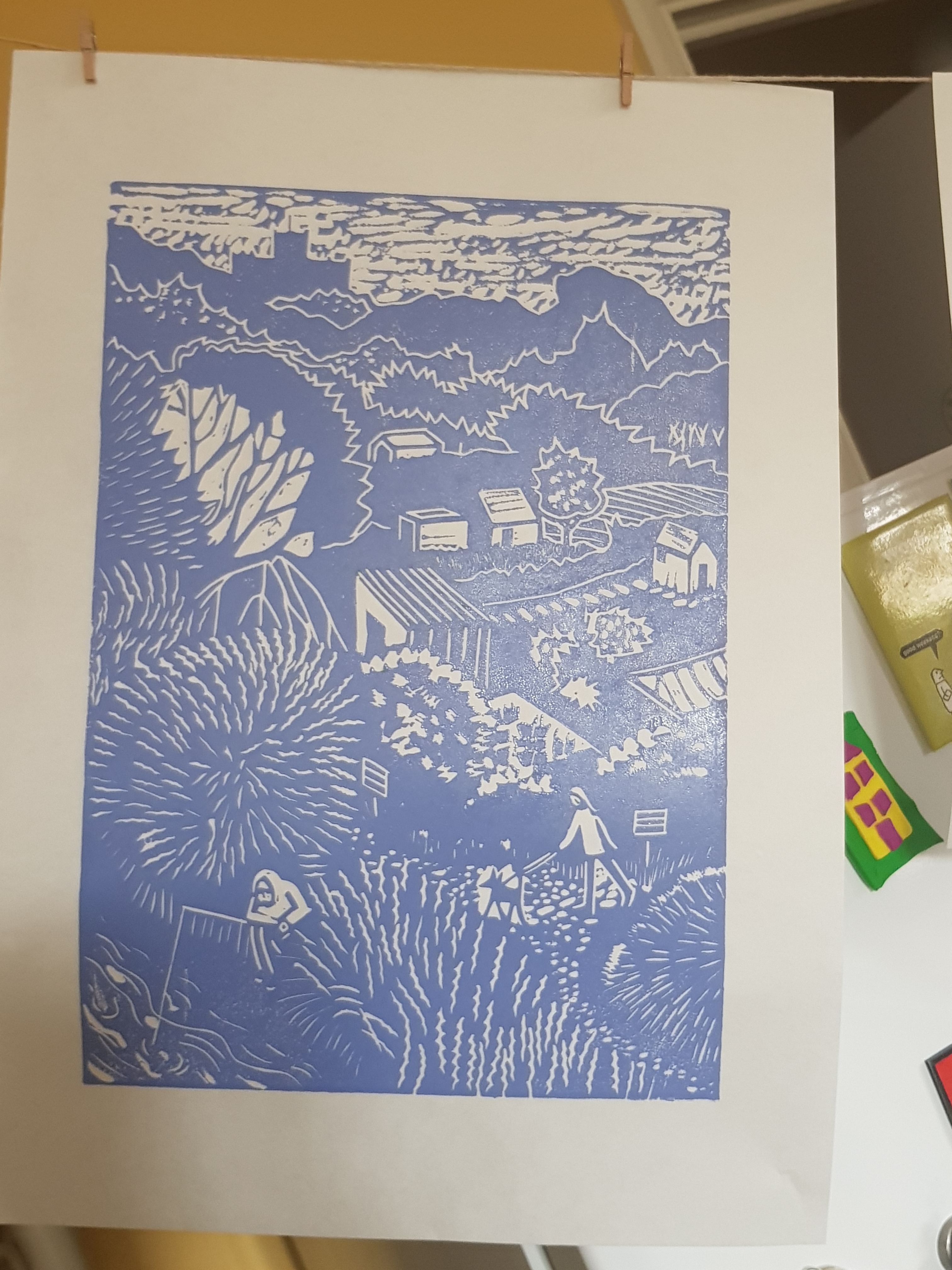
I feel that this piece, though initially inspired by a scene created by Jane Dignum “Poppies on the Allotment”, has more to do with the dictates of the governing state, as symbolised by an historical monument – St Albans Abbey – and how people’s lives, whether in their best interests or otherwise, have been and remain controlled from the top down. The eye travels down from this monument through the suggested toil of the land to individuals themselves as they go about precious leisure time. These people are essential elements of a scene to lend life as well as scale. They are also rendered almost insignificant by the vast wealth and magnitude of the institutions that govern them from afar.

In short, hopefully I have managed to express my feelings about the status quo under the guise of a simple image representing our much loved green and pleasant land.

Part 2: Project 7 (Task 3): Multi-block Print: “Bottle Alley”

Although I have yet to complete on Project 6, “Abbey View”, I thought I’d make good use of the time available to me before the sunrise. Hopefully that’s not too nauseatingly enthusuastic of me.

I like the loneliness of this image. I considered the addition of a gull to add a bit of life to the scene. But I’ve decided to leave it as a stark representation of the sense of isolation we feel during COVID times. The scene of an abandoned beach – which would usually have at least a few dog walkers in evidence, even in winter – puts me in mind of how this pandemic affects everyone, no matter where we live.

I have set about my design for “Bottle Alley” based on an image I captured in a drawing, as well as a photograph, in late 2020.

Bottle Alley 2020
Bottle Alley reference photo 2020

I replicated this flipped image via tracing paper and photocopier and made preparatory notes on each as follows:

Notes for each of the four plates required for “Bottle Alley”

I shall allow this project to formulate in my head awhile. In the meantime, it’s back to concentrate on producing a decent print of “Abbey View”

Part 2: Project 6: Single Colour Linocut (Task 2)

I started with a photograph I had taken last summer – a south-eastern view of St Albans Abbey including some allotments. I’d decided my picture was going to be about the simplicity of a rural scene but depicted during these complicated and interesting times. This scene was captured last summer sometime after the first lockdown. Masks were not yet de rigueur. There were signs up to warn people to maintain their distance. I have included figures in my scene to lend interest to the foreground.

View of St Albans Abbey

I had been careful to think about transferring the drawing onto the lino and how it would become mirrored. In order to avoid this I first flipped the image on my phone. I then drew the above. Then I attempted to transfer it onto the soft polymer lino using graphite paper. However, when this failed to work, I simply drew a version of my drawing onto the plate with a black sharpie pen. When I’d finished, I realised I had drawn the incorrect orientation of the image. However, I looked at both versions and eventually arrived at the decision to leave it as it was, as the resultant print would likely depict a better composition and therefore an improved outcome. This would be due to the western convention of reading an image from top left to bottom right. The first thing to notice is the skyline with the Abbey itself. The eye then meanders its way down the image and exits via the pathway leading to the bottom right hand side. As it was also not that well known a view, I didn’t think the orientation would matter that much.

First cuts (incorrect, though preferred, orientation for printing)

Using my first test plate from Project 5 as a reference tool, I chose a Pfeil No 11 “v” shaped tool and cut outlines to key areas, as above.

I then took an initial proof onto newsprint.

Initial proof on newsprint

I made some decisions about how to proceed, and cut a little more using a Pfeil No 5 “u” shaped tool. These Swiss tools are very sharp and sit nicely in the hand making light work of the butter soft polymer lino.

Second proof on newsprint

At this point, I have decided to be a bit bolder about creating areas of contrast in the foreground. But I hesitate – slightly nervous of making a hash of it. I feel that my attempts at a “mackerel sky” are more evocative of an apocalyptic one. I shall take further steps to create slightly less texture in the sky and draw more attention to the foreground area, thus:

The coloured outlines surround areas for development. I’ll utilize varying degrees of contrast using more contrast than I had first intended

More tomorrow.

Part 2: Project 5 (task 1) Preparing a Test Linocut

I cut the following (roughly A4) piece of lino using decent cutting tools.

Test linocut

I made the following notes as I cut:

Test cut notes

To clarify, in the top third of the 24 boxes in the grid, I have cut lines of varying depth and pressure using Swiss Pfeil tools numbered 5, 7 (wide), 7, 9, 11, 12 and 15. The wide and shallowly-curved Japanese chisel tool has been used just before the last Pfeil tool (No 15). It created some interesting zig zag lines when swiveled left to right as I cut.

Using this same sequence running from left to right on the next, or middle third, this time I have created various gouge marks. The Pfeil No 7s were very leaf-like when doing a zigzagging gouge. Pfeil No 15 is reminiscent of flames, I thought. I was intrigued to see how it printed.

Again, using the same sequence, I used all 8 tools to create cross hatching effects for researching “shading” purposes. I feel that the v shaped blades are most useful for the purpose of highlighting areas, but where not too much light is in evidence, rather than cutting a whole area of lino away entirely, which would suggest a very strongly lit area.

I learned much from this Exercise. I shall use this to inform my texturing on the next Project (6), aka Task 2. For this, due to COVID-19, I shall be falling back to a sketch I did recently of “Bottle Alley” in St Leonard’s-on-Sea sea front.

“Bottle Alley “

Update:

Change of plan. I shall hold back on using bottle Alley and save it for the multi-block print Exercise for Project 7 (task 3). This is because there is more scope for colour variety and layering on Bottle Alley which would add to interest. Instead I shall be using a sketch from the summer for the single plate linocut as follows:

View from Alban Way

Formative Feedback on Assignment 1

  • I was hugely relieved to receive largely positive feedback on my first assignment for the Printmaking Module Part 1. Pleasantly surprised to have my Printmaking submission described as “exciting work”, I am motivated to move on with the next part of this module relating to linocut.
  • The critical feedback I received was useful in that my tutor has provided me with tools to develop my personal voice. She suggested I use mind mapping methods to brain dump my thinking around the reasoning behind the “Why” I chose certain objects. This should be by using universal language, rather than simply telling about the specifics of how those objects came into my possession. She said to ask myself pertinent questions about how I feel the work (both my own and historical/contemporary artists) could/will be interpreted by the viewer.
  • Again, I need to use this personal voice to communicate an intent at the outset in making decisions about the technicalities of the work, and the research underpinning it. Also, during production reflect upon how I feel about the printmaking outcomes as they emerge – that moment of magic. (I could also record mistakes and happenstance)
  • My tutor also mentioned paper stock (together with a link to a supplier of Zerkall 120gsm paper). She added that my use of cheap A3 photocopier paper was limiting the effects of the oil based ink I was using, which had led to an unwelcome blotchy effect on some prints.
  • Rather than listing the specifics of how I find objects, I could be describing what the assembled objects are about. Talk about the themes behind the work, whether it be family/memory/emotion/relationships in form, colour or texture etc. Does the work pose a question to the viewer, or seek to make a statement in some way?
  • I also need to do some wordpress blog admin – a dedicated space on my website menu – for recording/navigating Reflection on Formative Feedback as well as for the purposes of Research blog posts.
  • My tutor also said that the project 4 prints were by far the best in this submission, that I had saved the best until last.
  • I should continue to use my sketchbook to record daily observation in sketches and notes etc.

Mind map the following:

The personal – specifics surrounding reasons for choosing a specific object or collection

the universal – how it may be viewed

the underpinning research – contextual studies

Technicality – paper, method/quality of inking, press, plate, spacing etc

Part 1: Assignment 1

To sum up my experience of monoprinting, if I’d had more fun with it, rather than cursing my lack of a perfect print, then this part of the printmaking module may have produced more positive outcomes.

For Project 1, I am submitting the following prints:

The “least bad” prints Project 1

These were produced by painting ink onto either a glass plate or one of copper. Clockwise from top left, these are printed on cartridge paper, newsprint, 120gsm Zerkal and basic A3 photocopier paper. The objects include a birthday gift of a sculpture from my sister, as well as the head of the Buddha – a rare gift from my younger brother – who found it in a skip on his way over to visit one day years ago. These objects have some degree of emotional attachment for me. Generally speaking, objects don’t hold emotional value for me particularly, though I do possess a lot of interesting objects in my flat. The pear is an ornament I picked up when out charity shopping with my partner, an example of a fun activity which we were once able to do freely.

For Project 2, I offer the following outcomes:

Project 2 Positive and negative masked monoprints

These are printed on white A3 photocopier paper, and on 140gsm black paper. From top left going clockwise they consist of a simple positive print from a negative mask (albeit white ink on black paper, just to confuse the issue), followed by a rare spotless positive print in yellow oil based ink on white paper. The next one is based on a sketch of the head of the Buddha and is a positive print from using a negative mask (again, somewhat confused by printing white on black). Finally, bottom left shows a negative print using a positive mask where the f holes in the violin have been cut out to show that extra detail.

The initial sketch of a violin was inspired by an instrument I have been practising for 3 years now. I am just starting to make actual music. The shape is particularly well suited for this exercise as it is so easily recognisable.

Project 3 Two coloured masked monoprints

For Project 3, I developed layers of positive and negative prints. Here I used bubble wrap to give texture to the background of the violin (bottom left). I was not entirely successful in registration of positive and negative prints in my outcomes, but I feel the effects are good enough to submit due to the colour combinations I have chosen to use. All of the above are printed on A3 photocopier paper using oil based ink. The print top left is my attempt at a landscape. Here I have used a brush to paint onto the plate as well as back drawing the clouds, thatched roof, and ploughed field.

There was a delay in awaiting a fresh order of supplies. I had a set which should have included oil based yellow ink, but in fact had 2 x black tubes instead. This was somewhat frustrating as I had to wait for my order to be delivered. But I am very pleased with the quality of the ink from Jackson’s. Needless to say that, in future I shall not be buying little sets on Amazon.

Finally, I am still working on Project 4. Please see previous blog post for the story so far. I shall update in due course, ever mindful that it needs to finished and dry for posting tomorrow (Thursday 14th Jan ’21) before noon.

Update:

This morning I have spent time attempting to finish Project 4 of Part 1, however the outcomes were not as good as I’d hoped. Rather than ask for another extension on this first assignment, which would be very last minute and not really on having already spent 3 months dithering I’m going to send what I have regardless.

Project 4:

On reflection:

Although not ideal, I feel that to get a perfect, or near perfect, outcome with the monoprinting method is a tall order. I could spend six months on this and still not come up with anything I’m really happy with.

I am looking forward to the next part of this module where we are lino printing. Hopefully I will have the opportunity to put what I have learned so far into action in Part 2. I will not abandon monoprinting entirely, especially if my tutor directs me to rework my assignment. But it has been a largely frustrating experience. I’ll be pleased when I can move on.