Part 5: Personal Project: First Steps in Chine Collé

I started this project by drawing spiral arrangements in my sketchbook. My thinking was to produce abstract designs for the final series of prints for this course unit.

I then went on to look at other people’s chine collé creations. This one, by Diana Croft, caught my eye. The archway suggested by the tree put me in mind of stained glass church windows. I thought I could have fun using different colours and patterns – including spirals.

Diana Croft

I produced a test plate with a basic church window, as follows :

Test plate

From this I produced my very first chine collé print:

Chine collé test print with tissue and textured paper

Enthused by this, I designed a slightly more complex image and went off to do something else for a while. That “something else” was, among other things, to dabble further in abstraction. I spent a few minutes following an online video on the subject of abstract painting by Tracey Verdugo. I then created the following images using contrasting elements as inspiration:
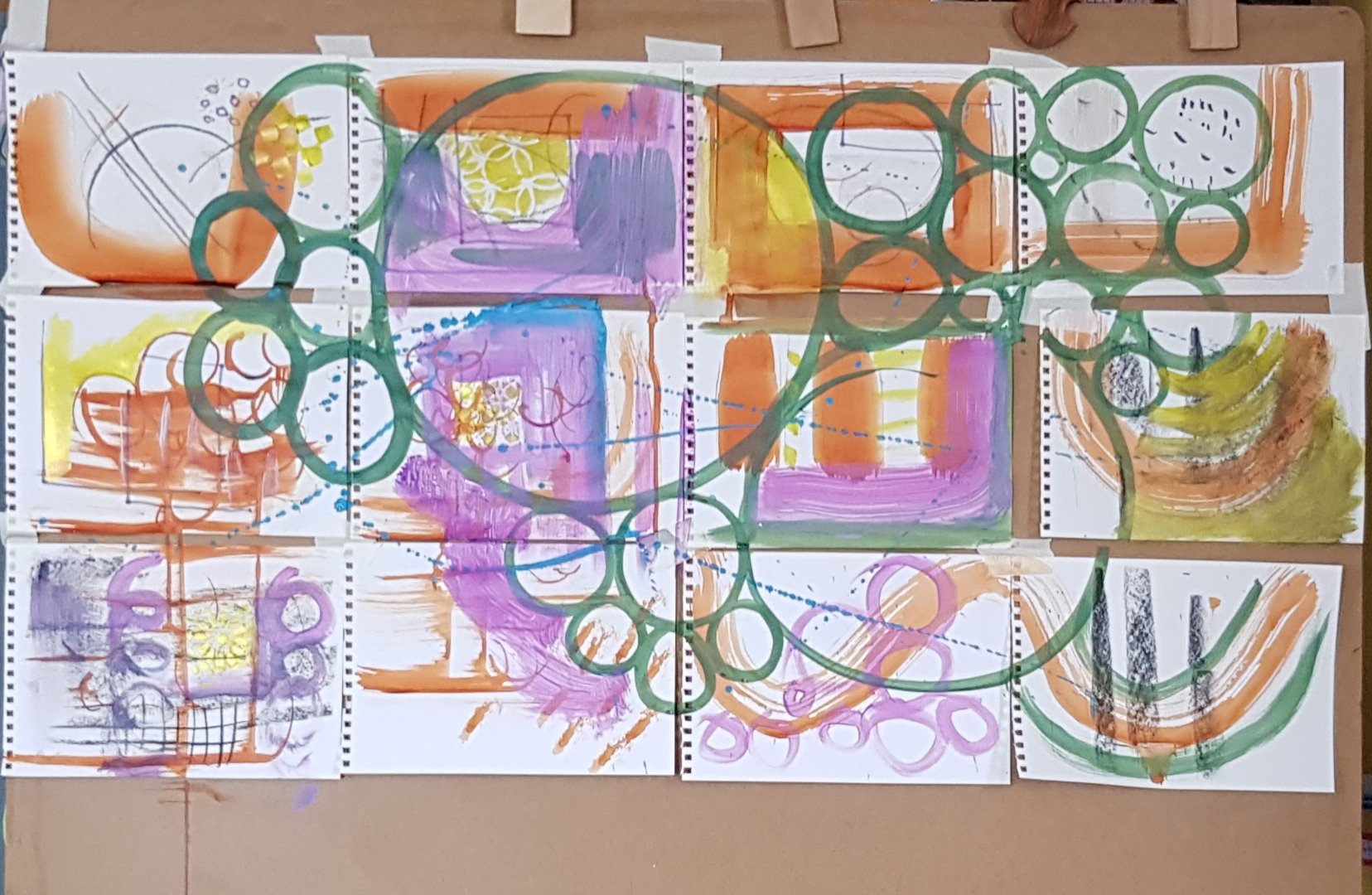
Buoyed by this, I extracted some of the more interesting elements from the whole piece and printed them out on my Epson printer. I then used these, in conjunction with my test plate to produce the following using the chine collé technique:

The more complex plate has now been cut, though further cutting may be required. I took the following proof earlier today:

Proof using basic lino printmaking technique

I have been experimenting using packaging from Amazon, McDonald’s and Aldi products, as follows:

Hand prints on packaging in the style of cave dwellers’ art from thousands of years ago

It is my intention to try to say something relevant about how Mammon, and the new religion which is consumerism, has taken over from the church as the chief mind control system of the masses. This is not to say that I think it has been any one person’s brainchild, more that it has been a gradual takeover since the industrial revolution. I find it to be interesting how people accept this transition almost as though it hadn’t happened at all. The church has been all but usurped from its position of power over western communities. Instead, branding is the new power.

I shall print over the top of this packaging with my church plate using chine collé technique. If I mess it up, at least I can console myself by purchasing another Big Mac – purely to acquire further packaging for the purposes of experimental art, you understand.

References:

Linocuts (no date) DIANA CROFT. Available at: https://www.dianacroftart.com/linocuts.html (Accessed: 18 June 2021).

Tracy Verdugo Art (no date) How to Paint Abstract Artwork for Beginners. Available at: https://www.youtube.com/watch?v=QdjfHmQ1JRc (Accessed: 8 July 2021).

Emin/Munch: The Loneliness of the Soul

I was excited about going into London to an actual physical gallery exhibition at the Royal Academy.  I wasn’t expecting to be overwhelmed by visual stimulation within 15 minutes of arriving, though. It was as if I’d used up my mental viewing credits for the entire month within moments of seeing my first red-splattered Emin canvas. My first thought was that there had been too few Munchs included in the exhibition.  But, as I walked around the small space – blissfully uncrowded by other visitors – I realised it had been well curated by Edith Devaney  The subject matter of raw emotion by these two artists leaves me emotionally affected.  So much so, that this bite-sized exhibition is just “on the money” as regards the quantity of pieces displayed. I’d been feeling a little jaded from a sensation of “the morning after the night before” (we visited the gallery on a Sunday afternoon) so, the splashes of red juxtaposed with green in both artists’ work had even more impact than on any week day, for example.

Tracey Emin. 2018. “It was all too much”. Oil on canvas

This exhibition spoke to me of the distress, not only of loneliness, but the confusion that is felt in the midst of post traumatic stress and depression. Having listened to an excellent Woman’s Hour interview with Emin on the subject of the exhibition,  as well as reading about it afterwards in “A Guide for Friends” handed out on entry, it brings it home to me again, the importance of context,  especially in contemporary fine art.

“Being an artist isn’t about making something beautiful,  let the designers make something beautiful. Our job as an artist is to battle with the soul. Sometimes we lose, but that’s what it’s about.” (Emin. 2021)

Reading this quote having just made the decision to move from a fine art discipline to one of illustration,  I feel something of having let myself off the “suffering artist ” hook. It is less necessary to “bleed” onto a canvas as an illustrator.  This leaves me feeling somewhat relieved. Rather than feeling deprived, it is as though I have escaped some future traumatic journey. Self discovery needn’t be quite so public, I feel. Though I appreciate it immensely when others take pains to do so, as Emin has done with this exhibition.

Edvard Munch. “The Death of Marrat”. 1907. Oil on canvas

ED asked “Do you see painting as the ultimate creativity?”

TE “Totally. I really love the fear of the canvas, the fear of the moment of beginning.  There are a lot of painters that work with grids, with projectors, with photography, or other people do the paintings for them. I’m not talking about that, I’m talking about the cave woman. I’m talking about the last woman on earth making a message.” Emin. 2021.

I love that reference to cave woman. It puts me in mind of my subject matter for the part 5 personal project, for the printmaking module, using chine colle. Cave painting will be a feature, I’ve just decided. I’m not certain how. But it’s definitely in there. What I have so far relates to commercialism as a new religion to control the masses. I’m thinking of a stained glass window effect using chine colle, but depicting, in place of the usual bible stories with saints etc, I will use images of cave painting and/or women involved in this activity.

References: 

Edvard Munch (1907) The Death of Marrat.

Royal Academy (2021) Tracey Emin / Edvard Munch | Exhibition | Royal Academy of Arts, Royal Academy. Available at: https://www.royalacademy.org.uk/exhibition/tracey-emin-edvard-munch (Accessed: 24 May 2021).

Tracey Emin (2018) It was all too much.

Tracey Emin (2021) ‘Emin/Munch The Loneliness of the Soul’. Available at: roy.ac/iamafriend (Accessed: 23 May 2021).

Woman’s Hour – Weekend Woman’s Hour: Tracey Emin; Susan Rogers, Prince’s sound engineer; Panic attacks – BBC Sounds (no date). Available at: https://www.bbc.co.uk/sounds/play/m000vwsl (Accessed: 8 August 2021).

Peter Wray, Gary Hume, and Dale Devereux Barker

Peter Wray

Half forgotten Voice. Peter Wray

Music is a major influence, especially Irish traditional music with its melodies providing a counterpoint for all kinds of musical adventures that underpin and are held within it. I love to explore the question – what is important: the dominant melody or those qualities that contain it or are contained within it? There is no such thing as “just a tune”, as there is no such thing as “just a drawing”’. (Wray. 2005)

The above quote rings familiar with me, as I too enjoy playing Irish music on my violin. I can see something of the gritty quality of the music in Peter Wray’s work. However, the work and the quote came simultaneously to me, so I’m uncertain as to which one initially influenced the other in my mind. Despite this, the texture of the work inspires imitation or future homage.

Gary Hume

Yellow Slip. Gary Hume

“These prints are inspired by recent paintings but after addressing formal issues such as colour, tone and line, they take on their own trajectories, qualities and personalities. It is therefore important to engage with the process to make the most of the opportunity to offer something fresh and beautiful.” – (Gary Hume. 2017)

I think, in saying the above, the artist is communicating that, similarly to when a book is written as a screenplay, fresh qualities emerge once a different process is used to develop the same or similar subject matter. I can imagine this image in 3D as a sculpture in clay or in bronze. It illustrates the importance, and the value, of investigating subjects through varied mediums.

Dale Devereux Barker

Connected. Dale Devereux Barker

The Bankside Gallery says of Dale Devereux Barker, “Since graduating from the Slade in 1986 he has developed a pictorial language which is distinctive in its combination of figurative imagery and complex layering of more abstract planes and textures scavenged from outside sources.” (Bankside Gallery Website).

I interpret this to mean that he doesn’t just make the shapes up in his head, but draws from the real world objects as well as the all important spaces between them. His artistic voice is established and recognisable to those who have experienced his work. I shall be looking out for it in future as I would be proud to list him amongst my influences.

References:

Dale Devereux Barker (2021) Dale Devereux Barker RE – Biography, Bankside Gallery. Available at: https://www.banksidegallery.com/artists/359-dale-devereux-barker-re/biography/ (Accessed: 17 May 2021).

Pyramid Gallery (2005) Peter Wray. RE Autumn Exhibition, Pyramid Gallery. Available at: https://www.pyramidgallery.com/B-sept05.htm#Work (Accessed: 17 May 2021).

Royal Academy (2017) Gary Hume RA: Prints Pictures | Exhibition | Royal Academy of Arts. Available at: https://www.royalacademy.org.uk/exhibition/art-sales-gary-hume-ra-print-pictures (Accessed: 17 May 2021).

Louise Bourgeois: Spirals

Spirals 2005 Louise Bourgeois 1911-2010 ARTIST ROOMS Tate and National Galleries of Scotland. Lent by the Artist Rooms Foundation 2013 http://www.tate.org.uk/art/work/AL00346

I return to Louise Bourgeois’s work as a reference point for the use of spirals in my own work. I have used this symbol as a way of presenting my ideas about community and society in general, from the micro, rose petal pattern, to the macro level of representing a sense of community, rather than as symbols representing themes surrounding personal relationships, as Bourgeois has done.

In the Tate article the word “Control” (Tate. 2005) is mentioned, but rather than in respect of being the one under control, Bourgeois sees the spiral as representing her own sense of having control. In that respect it is a more subjective use of the symbol – presented here in the form of a grid. The minimalist use of primary colours gives them additional impact. I may consider using this device in my own presentations in future.

References:

Tate (no date) ‘Spirals’, Louise Bourgeois, 2005, Tate. Available at: https://www.tate.org.uk/art/artworks/bourgeois-spirals-al00346 (Accessed: 15 May 2021).

Reflection on Feedback to Assignment 3: Lifeforms

Again, I was very relieved to receive such positive feedback for this assignment. My tutor made some constructive comments from which I have gained the following insight into how I could progress from now onward:

Continue to keep a sketchbook – use a small one to carry with me at all times and add items of interest as well as small sketches and notes.

Research more sophisticated academic sources. Try UCA ebooks.

Make influences and intent more explicit in my work. Why yoga? Why 1920s influence? What are the emerging themes around this and other works?

Review knowledge on referencing rules for Harvard refs – particularly within the text.

Invest in a copy of “How To Write About Contemporary Art” by Gilda Williams. READ it.

Look at the following artists:

Peter Wray

Gary Hume

Dale Devereux Barker

Pandora Johnson

http://www.inkidot.co.uk

Notes on next assignment:

Less is more with collagraph printmaking. Avoid an inky mess by leaving some areas of the plates blank.

NB. I have since started to carry an A6 sketchbook which is all but full of notes, photos and sketches relating to projects and random ideas. This is together with the larger, square kraft paper sketchbook which I usually keep and send with my assignments – although I do not always prepare sketches before launching into a project ( see Assignment 4 “Control” – to be submitted). Some of my pieces are more spontaneous in nature than others.

Update: Project 12

I’ve been waiting on paper stock supplies so that I can print from my latest collagraph plates. Having made them a bit too large for my current paper stock, I ordered further heavy weight paper from Jackson’s. This has turned up today. So tomorrow, bright and early, I shall recommence proceedings.

The following plates are what I came up with in response to the abstract brief for Part 4 of Introduction to Printmaking. My initial intention to work with the themes optimism, movement, balance, and flow have morphed into those themes surrounding COVID rules and how we have responded to them. Instead, I have created plates entitled, “community”, “containment”, “control” and “contamination”.

Craft lolly sticks, bubble wrap and O rings

The above was developed from the sketch below on the facing page of my sketchbook.

My thinking behind this was about the organic nature of society and community. I likened it to the petals on a rose, only a bit more rigid in nature. The sticks are arranged sympathetically with one another to form a structure that is supportive, but also adaptable. The next plate was an attempt to create an image that depicts how it feels when patriarchal societies seek to exert control over the population.

“Control” plate with corrugated packaging and metal washers

I arranged the the above plate without prior need of sketches, as I had quite a clear idea in my mind of what effect I wished to achieve. I was pleased with the outcome below.

“Control” Print on damp 250gsm Fabriano UNICA printmaking paper 28cm x 38cm

The enforced rigidity of the movement of the circular motifs in this print call to my mind a metaphor for limited freedoms during COVID-19 and its various strains. Whereas, the following print taken from the plate for “Containment” is less rigid in structure. It appears to exist via faith alone, as its building blocks do not adhere to the more solid rules in the print called “Control”.

Containment

The next two images are plates at various stages of completion. I need to take prints from these to determine what to add or to subtract from them to depict “Contamination” and “Community”

“Contamination”

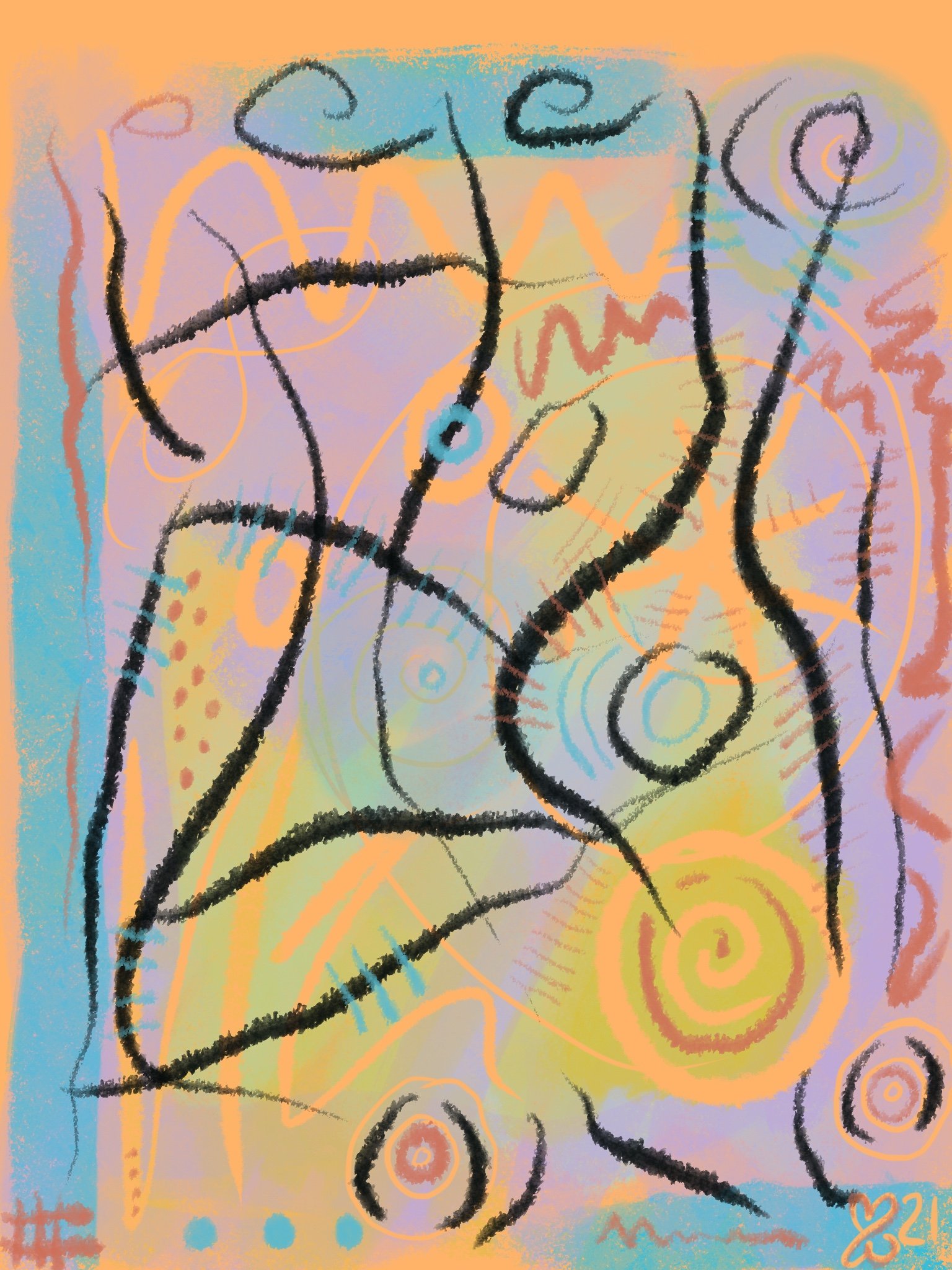
The above plate was inspired by the following doodle which I scrawled onto my iPad, printed off, then added to using biro and highlighter pens.

Sketchbook doodles inspiration for “Contamination”

The above sketch was in turn prompted from looking at images of the Delaunay bisected concentric circles with their rich colour juxtapositions. I shall enjoy playing around with my own colour choices now that my paper has turned up.

The following is another plate – a version depicting “Connection”. Here, I have used string to form the double spiral and metal washers to ‘populate’ them. The external negative space has been textured using poly filler and sand, and by pressing corrugated card into the surface whilst not yet set to give the surface small ridges.

“Connection”
“Connection” printed on damp Somerset satin 300gsm printmaking paper

There is an inadvertent smiley face in this image. Appropriate or not, it is clearly visible. Perhaps re orientating it to landscape would eliminate this unfortunate effect:

The following is entitled “Contamination” to continue with the theme of how the pandemic has affected social cohesion. There is something about the way the spiral holds both the occupants and contaminants equally within its organic structure.

Collagraph plate for “Contamination”
“Contamination” print on Somerset satin 300gsm printmaking paper

References:

Tate (no date) The EY Exhibition: Sonia Delaunay – Exhibition at Tate Modern, Tate. Available at: https://www.tate.org.uk/whats-on/tate-modern/exhibition/sonia-delaunay (Accessed: 14 May 2021).

Part 4: Project 12: Abstract Collagraph

(Task 12)

The best (if not the only) way I can view, and try to understand non-representational art is to think of it as analogous to something else.

I attended half an online taster session in Art Therapy at the University of Hertfordshire a few months back. We were instructed to close our eyes and, with a pencil, try to locate the edge of a piece of A4 paper without going so far as to allow the point of the pencil to wander off the edge of the paper, and mark the surface of the table. Other people drew lines around where they perceived the edge of the paper to be, as though pacing a cell and surreptitiously checking for weak points . I attacked this imaginary boundary. When I was done, and opened my eyes, I saw an elongated, jagged edged shape on the landscape sheet of coloured paper. I interpreted this to mean that I was like some kind of rabid beast, hell-bent on escape from – exactly where?

The reason I recount this now is because I feel it illustrates my view of non-representational art. It’s like painting a tiger with your hands tied behind your back. (You can’t paint with your feet because you’re busy using them to run from the tiger!)

Flights of fancy aside, I do find abstract art interesting, if a little perplexing. So it is with some trepidation and with a spirit of adventure that I embark upon this latest project.

Part 4: Project 11: Collagraph Test Prints

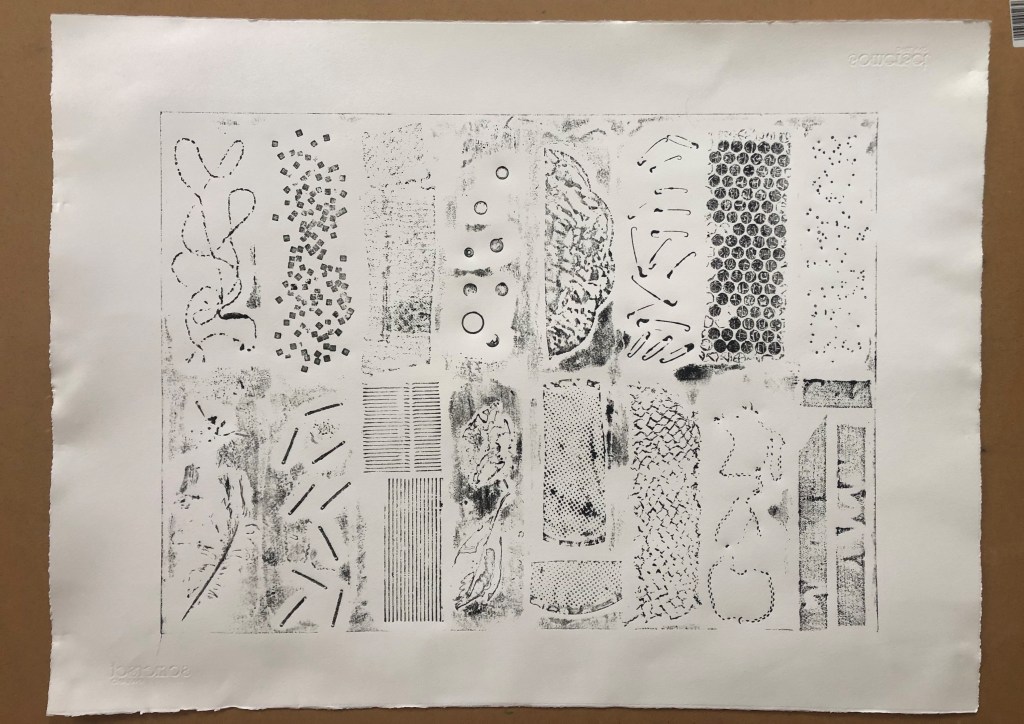
A1 test plate – prior to inking (Flipped then annotated)

So keen was I to take prints from my test plate, that I neglected to look at the directions in the course text. I went ahead and inked my plate using some scrunched fabric. Without dampening the paper, I took two impressions.

The resulting prints were a little as though a spider had wandered across the paper with dirty feet. However, I have, at least, learned that certain materials work more effectively than others.  Not dampening the paper prior to printmaking led to weaker results, but it did at least tell me which materials were most impactful.

The following is the initial print onto dry smooth Zerkall 120gsm printmaking paper. I like this print. At least all items made some impression. The best effects came from the corrugated card, the bubblewrap and the mosaic tiles. I’m excited to move onto developing another plate – this time using a smaller piece of mountboard as the only paper I have that’s heavy enough to take dampening is my Somerset paper, which I have only in smaller pieces than the Zerkall seen below (54cm x 76cm).

Initial print

I think, with the next plate, I shall attempt a more interesting and cohesive composition, rather than redoing the test plate exercise. I intend to continue with the themes of optimism, movement, balance and flow.

Update:

The following day – feeling optimistic- I set out to rectify yesterday’s error and dampen the paper before printing. This was overly ambitious in scale as the Zerkall paper I have is not quite as robust as Somerset, for example. Therefore it buckled somewhat under it’s own sodden weight. However, I took two prints regardless, as follows.:

Print on damp Zerkall 120gsm with black oil based ink rolled onto the plate
Print onto damp Zerkall 120gsm – black oil based ink pressed onto the plate

I’ll wait for the ink to dry before attempting to flatten the paper under some blotting paper and some form of weight.

Update (May 2021)

Test print on 56cm x 76cm Somerset 300gsm satin printmaking paper – soaked for 10 mins then blotted before printing

The above print is a lot clearer than former attempts using lighter weight paper – either dry or damp. I feel that the most successful items used here are the bubble wrap, mosaic tiles, beads, and corrugated card. I shall use these in further print plates for Project 12, the abstract composition.

Part 4: Abstract Art: Research Point

Wassily Kandinsky

Color Study. Squares with Concentric Circles. Wassily Kandinsky (1913)

The above image, though not a finished outcome in itself, is readily recognisable as the work of Wassily Kandinsky. You can see the texture of the watercolour paper where the artist used a sketchbook to work out different colour combinations as a reference tool for later works. I can imagine this was a most useful piece of work: time well spent in researching how different colours worked against, or with, one another when seen together like this. It is a great example of how preliminary work is an important part of the process, and that rushing headlong to the finished article is seldom an optimal way to produce art. I will take from this the lesson to work up to a finished outcome using a sketchbook and to play around with colour and form. This, as well as useful and pertinent note-taking, will further enhance the effect of my outcomes as well as my process.

Mark Rothko

No 5 – No 22. Mark Rothko. (1950)

Mark Rothko is another artist obsessed with colour combinations. He used thin layers of different coloured oil paint to produce luminescent outcomes on huge canvasses. When hung in galleries and viewed, these outcomes produce, in me anyway, certain emotional responses, speaking directly to one’s subconscious. This is perhaps not surprising, as Rothko himself is reputed to have said that “Art, to me, is an anecdote of the spirit”. Seen here on this tiny screen the full import of these works is hugely diluted. As with so many works of art, you have to be there to fully experience the intended effect.

Jackson Pollock

Summertime: Number 9A 1948 Jackson Pollock 1912-1956 Purchased 1988 http://www.tate.org.uk/art/work/T03977

There was method aplenty in Jackson Pollock’s “madness” here. The results of his famous drip technique are seen above. Again, the scale of this image has not translated well to a computer screen. A visit to the Tate to fully experience this piece is advisable. It speaks to me of graffiti art. There is a haphazard pattern in the movement of the punctured paint can as it deposits its contents over the canvas. This rhythm is analogous to the rhythm of life itself, or as its title says “Summertime”, the pattern is reflective of the seasons. Punctuated with primary colours, the black splashes are almost like an overly stylised font which attempts to communicate the unintelligible. It’s a fun, chaotic pattern, if that’s not too much of an oxymoron.

References:

Green and Maroon by Mark Rothko (no date). Available at: http://www.markrothko.org/green-maroon-1953/ (Accessed: 17 April 2021).

Jackson Pollock: 100 Famous Paintings Analysis and Biography (no date). Available at: https://www.jackson-pollock.org/ (Accessed: 17 April 2021).

Mark Rothko | Artnet (no date). Available at: http://www.artnet.com/artists/mark-rothko/ (Accessed: 17 April 2021).

Mark Rothko | MoMA (no date) The Museum of Modern Art. Available at: https://www.moma.org/artists/5047 (Accessed: 17 April 2021).

Tate (no date a) Jackson Pollock 1912–1956, Tate. Available at: https://www.tate.org.uk/art/artists/jackson-pollock-1785 (Accessed: 17 April 2021).

Tate (no date b) Wassily Kandinsky 1866–1944, Tate. Available at: https://www.tate.org.uk/art/artists/wassily-kandinsky-1382 (Accessed: 17 April 2021).

Wassily Kandinsky – 610 artworks, biography, books, quotes, articles (no date). Available at: https://www.wassilykandinsky.net/ (Accessed: 17 April 2021).